Doomed from the start. It took me a while to figure this out, but ATProto is generally a bad idea; maybe even worse than Twitter.
Which is to say, it provides a more robust model for your (true) information and data to be exploited by others than even the Twitter model.
The Mastodon-slash-email model that relies on individual servers is better because decentralization is safer -- Those models bear more genuine "ability to delete" and more "plausible deniability."
The Mastodon model does not offer much ability to delete. Well-behaved servers will honor delete requests, but the protocol doesn't mandate it. Additionally, a user cannot generate delete requests if they get banned from their server or the server shuts down. Users and server admins can't control whether another server permits archiving of their content. Mastodon and other fediverse software allows following public posts by RSS, and RSS clients might keep them forever.
The only reasonable understanding is that these protocols are for for publishing to the public. It is not possible to reliably retract anything published to thousands of other peoples' computers. We used to try to teach people that the internet is forever, and that's even more true with federated protocols. That doesn't make them a bad idea.
I think it's important to remember that decentralization is a barrier to having control over your data. If you're going to participate in these systems, you should treat everything you do as permanent, because by design you will not be in control of where that data is stored.
You can save all of anything someone makes public with ATProto, ActivityPub, or RSS. You can do that with anything someone puts on a web page too, but those protocols simplify automation.
I understand why people want to be able to delete things from the internet, but it doesn't work that way. It has never worked that way. It can't work that way unless every computer is locked down to running remotely attested government-approved software, and that's obviously worse.
ATProto won't be this way for much longer. Permissioned data is coming and will not be broadcast or accessible without grants. This will sit next to the public data, but separate.
How do you think about Google Docs? I consider that "on the internet" since it is not on my computer. Same for private channels and threads in Discord.
Also, ATProto can be much more than social media tech, more like a plug-n-play distributed system
Are you serious? Y'all are so confused about what this is.
The entire point of services like Bluesky and Twitter is broadcasting your activity out to the internet for anyone to see (which of, course, is technically little-or-no different from "grab")
ATProto is not Bluesky, the later is just one app on the former. There are many more apps like Tangled, git on ATProto, which need private repositories.
You seem rather confused. I do not work for Bluesky. I am an independent developer building completely separate applications on ATProto.
Fair, I'm aware and I am conflating what people do with Bluesky and what ATProto can do. I absolutely do see the value in ATProto doing things that aren't "social media"
Or more precisely, it might. We now have a better idea of how people actually behave and it's not in accordance with "the internet is forever," and I have no interest in blaming them for 'human nature' in that way.
And it's all still dangerous. Again, I know the internet is forever, but someone else posting about ME might not.
This isn't an individual thing. It's "ecological."
And I have no interest in making Big Brother THAT MUCH EASIER to build.
This comment seems to be saying you don't want most people to do blog-like things. Most social media from Facebook to Youtube is blog-like if you squint.
It does seem like fewer people are posting personal content that way lately. Perhaps most people are better off sharing things one to one, or in small groups that are meant to stay private. That doesn't make it bad for the more public formats to exist; they're just not for everyone.
You can care a lot about plausible deniability and the ability to delete your own data, but it seems a bit weird to denounce a whole ecosystem as "generally a bad idea" on those grounds, when that is a deliberate anti-goal of the system design.
Don't use it if you don't like it. Some of us like the strong identity and content verification.
"Don't use it if you don't like it" is not a sufficient response here, because the gathering and verifying of personal data is NOT PURELY AN INDIVIDUAL PROBLEM. You might post about me. Etc.
Proverbial Big Brother ALSO likes "strong identity and content verification."
No clue what that refers to, it's not at all what I'm saying. What I'm saying is -- we can observe that "don't post what you don't want posted" is an insufficient response to our current internet in terms of safety and publicity.
I'm also putting forth the idea that the ATProto thing for social media makes us marginally less safe, due to its technical "centralization via confirmation" of the data it "broadcasts."
The community has voted for convenience over privacy, and twitter and bluesky have won over mastodon. You're right, but people don't actually care about privacy
Bluesky is very intentionally about public posting. It's a bit weird to say people "don't care about privacy" when speaking of a platform designed to amplify and distribute posts as widely and effectively as possible.
There is a lot of weirdness around Mastodon, particularly some people can’t seem to make up their minds if they want the stuff they post to be visible or not.
Exactly. And I'm willing to be that Bluesky folk might be somewhat similar because they haven't figured it out yet.
Except that the design of Bluesky severely increases the possibility of your data getting out of your control. And I can hear the immediate responses of "oh if you didn't want it public, don't post it," but as should be frightfully obvious -- not everyone thinks like that.
Mastodon doesn’t give you any real privacy. If I’m posting on something twitter like I want as much reach as possible. Sorry bud, we’re not actually all dumb naive people who haven’t seen the light.
Unfair characterization. You can make informed prediction about these 2nd order effects without thinking they are dumb. I don't think people who send nudes with Snapchat behaving as if they will be definitely deleted are dumb either because, you know, the heart wants what it wants.
That doesn't mean that there is no danger of people having "buyer's" regret later, or more importantly that there are issues beyond the individuals.
I 100% agree, I always thought that even Private Messages were a bad idea.
But no, we're way past "if you don't want it public don't post it." and then wiping our hands and being done. We need to think in a policy kind of way on this.
And again, things are already dangerous -- but ATProto makes them more dangerous. It's something like a chain-of-custody thing. I think the world is collectively safer where the gathering of data like this is less reliable and less verifiable.
ATProto's model makes the building of the proverbial evil Big Brother panopticon thing a LOT easier.
I'd rather say Twitter and Threads are the current winners if we're talking about userbase. Bluesky is basically in the same league with Mastodon while those two are so far above that you can't even see them without a telescope.
If a social network stays comparatively small but still active, I see that as a huge win. Half the people I follow are happily on Mastodon. I don't see that changing anytime soon.
As someone who was once an avid twitter user, my sense is that Mastodon--after a somewhat hopeful start just never gained the network momentum. Bluesky came closest to Twitter's old reach but is still something of a shadow of the old Twitter (as Twitter/X is these days as well).
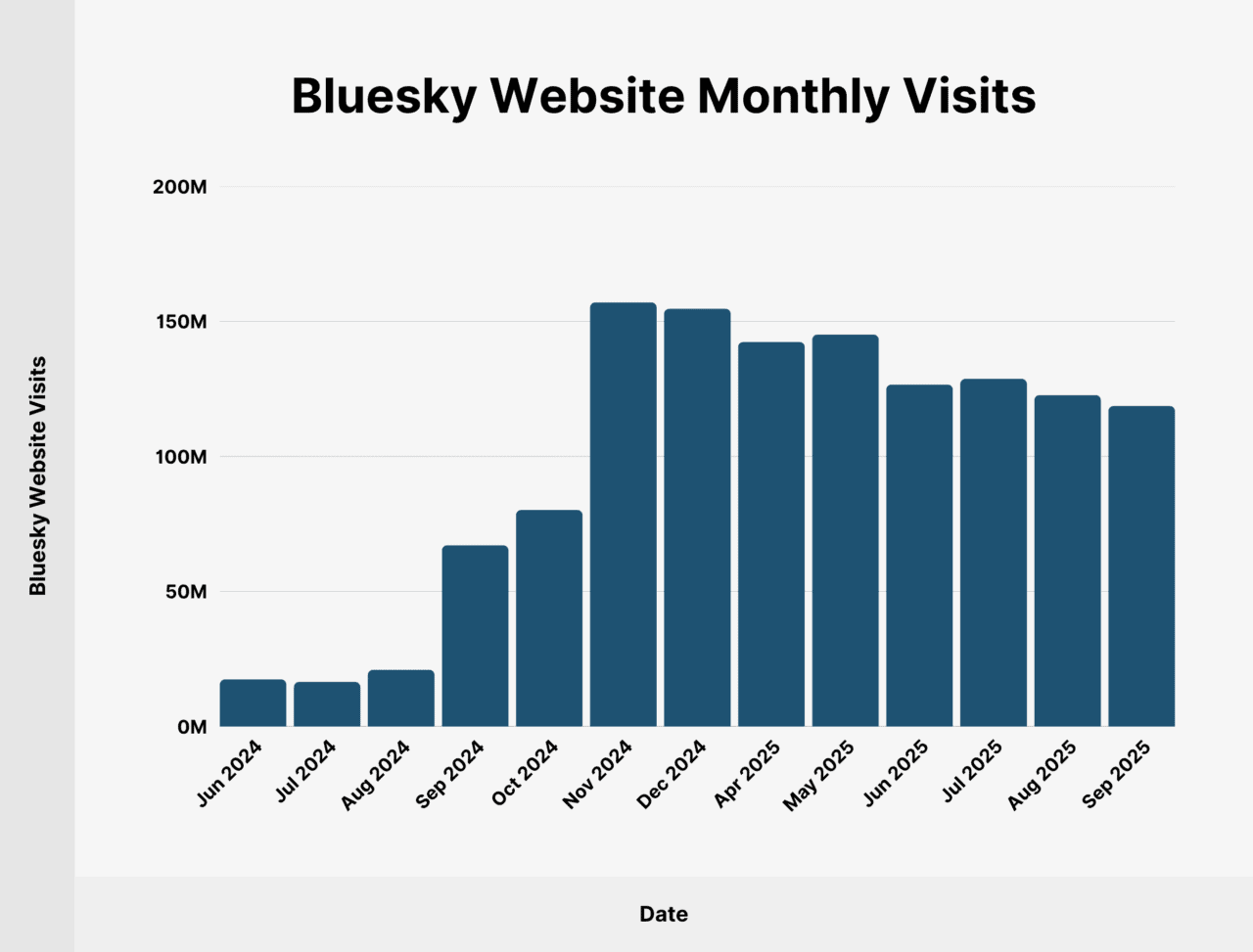
Bluesky is not just a shadow, it's on a pretty steady decline. Their DAU numbers are dropping every month. Which probably tells you something about the unspoken reason for this change.
Ah, I didn't realize the link I shared was Jaz's (it was shared in another comment), but they look similarly sideways over the past 6 months, with a noticeable bump in Dec / Jan.
Without researching actual numbers, it feels like that whole category of social media is pretty much uninteresting at this point. Not sure what really replaces it given that Facebook seems increasingly infested with AI slop and sponsored posts.
I mostly don't like this take because it presumes a precise definition of privacy that we all agree on. And it's not even remotely close to that, which is why I think the Bluesky model is perhaps insidious.
deleting published stuff in any sort of decentralised network is always going to be limited at best
there is just no way to police what happens to data that is broadcast, which doesn't remove control away from the reader
it's annoying because in the abstract it's something everybody has the potential to need and need badly, but if you're afraid to put something out there to your name/pseudonym you really shouldn't
What? You don't even need to understand how Mastodon works in depth to realize that sending a post to 500 different servers owned by completely different people in completely different jurisdictions is going to make it harder to delete later.
Sure -- but it also makes it harder to verify. That's my issue with Bluesky, perhaps I'm thinking like a lawyer. ATProto's most touted feature is also its biggest danger. A post on 2 servers thats hashed/verified (and perhaps admissible in court) might be more dangerous than many more rando Mastodon servers.
Not being able to trust the integrity of the data on the Mastodon network to the point it's not admissible in court is not a good thing for Mastodon. If this is really true, I'd say it's a completely failure of the most fundamental concepts of information technology.
AGAIN, we are way past SIMPLE SOLUTIONS like this. We have enough data and information to be able to see the potential for harm that we can mitigate through smart policy without falling back on this simple argument.



Which is to say, it provides a more robust model for your (true) information and data to be exploited by others than even the Twitter model.
The Mastodon-slash-email model that relies on individual servers is better because decentralization is safer -- Those models bear more genuine "ability to delete" and more "plausible deniability."