All "haha, but it's tasty!!!!" jokes aside, and even ethics and morality aside (which is tough, because we cause a LOT of suffering here), growing meat is just incredibly inefficient. We have to sustain so much additional biological machinery just to chop off some muscle tissue at the end, even if we assume everything of the cow will be used eventually, it's just incredibly wasteful.
The problem is that we don't factor in the externalities adequately in the price of most products.
Building and operating an amusement park is also incredibly inefficient just to get a giggle. If every product would be priced in a way that includes all externalities you'd see a shrink in the industries with the highest (negative) impact.
I'm setting aside the Pandora's box discussion about allowing only the rich the luxury of destroying the environment.
I know someone who works in agriculture reform and the lobby against any change is tough
Like they get outspend to an incredible degree. You are not choosing, they are telling you what to choose. It doesn’t mean change isn’t possible but you are swimming against a powerful current called Lobbying and Marketing/Influencing.
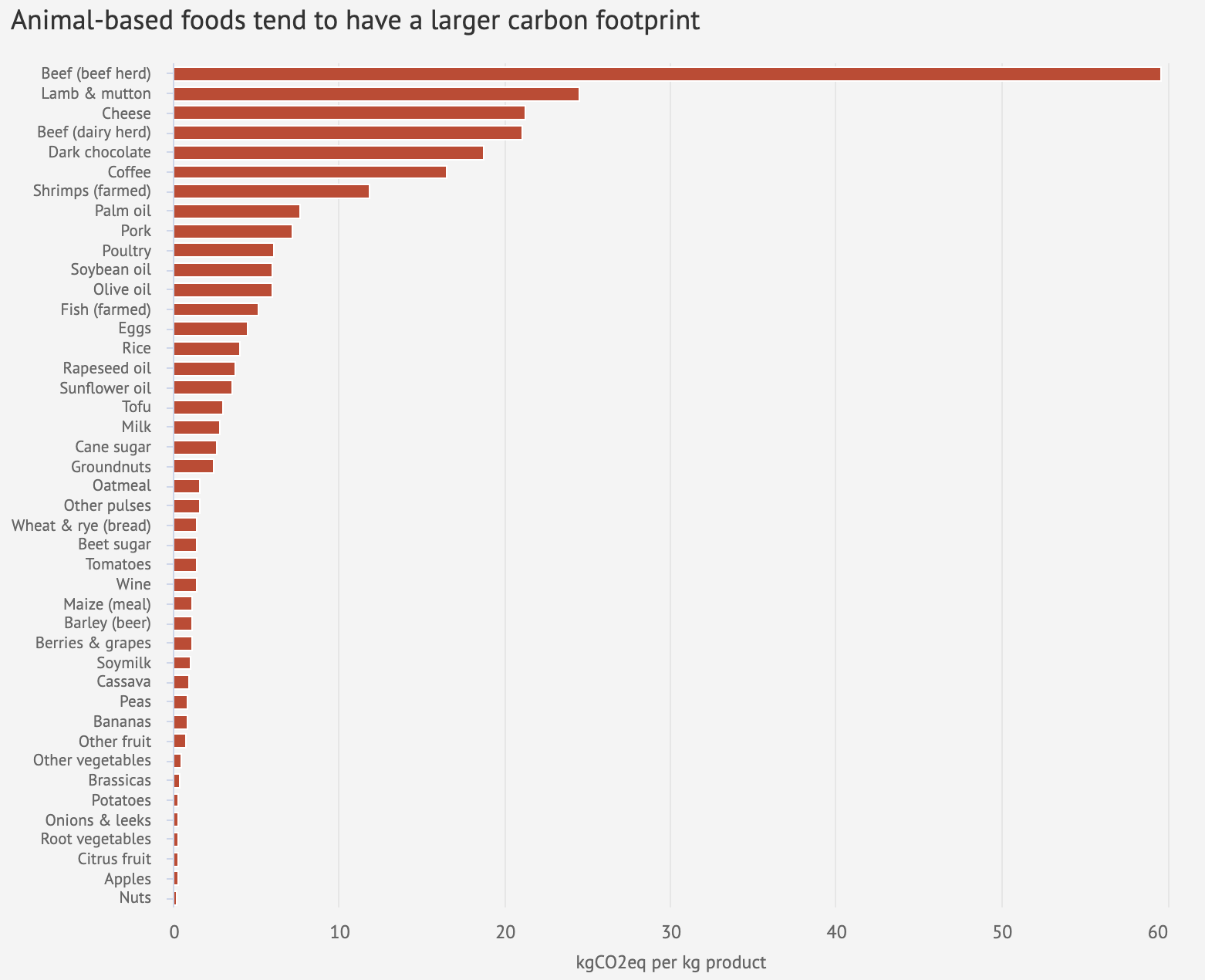
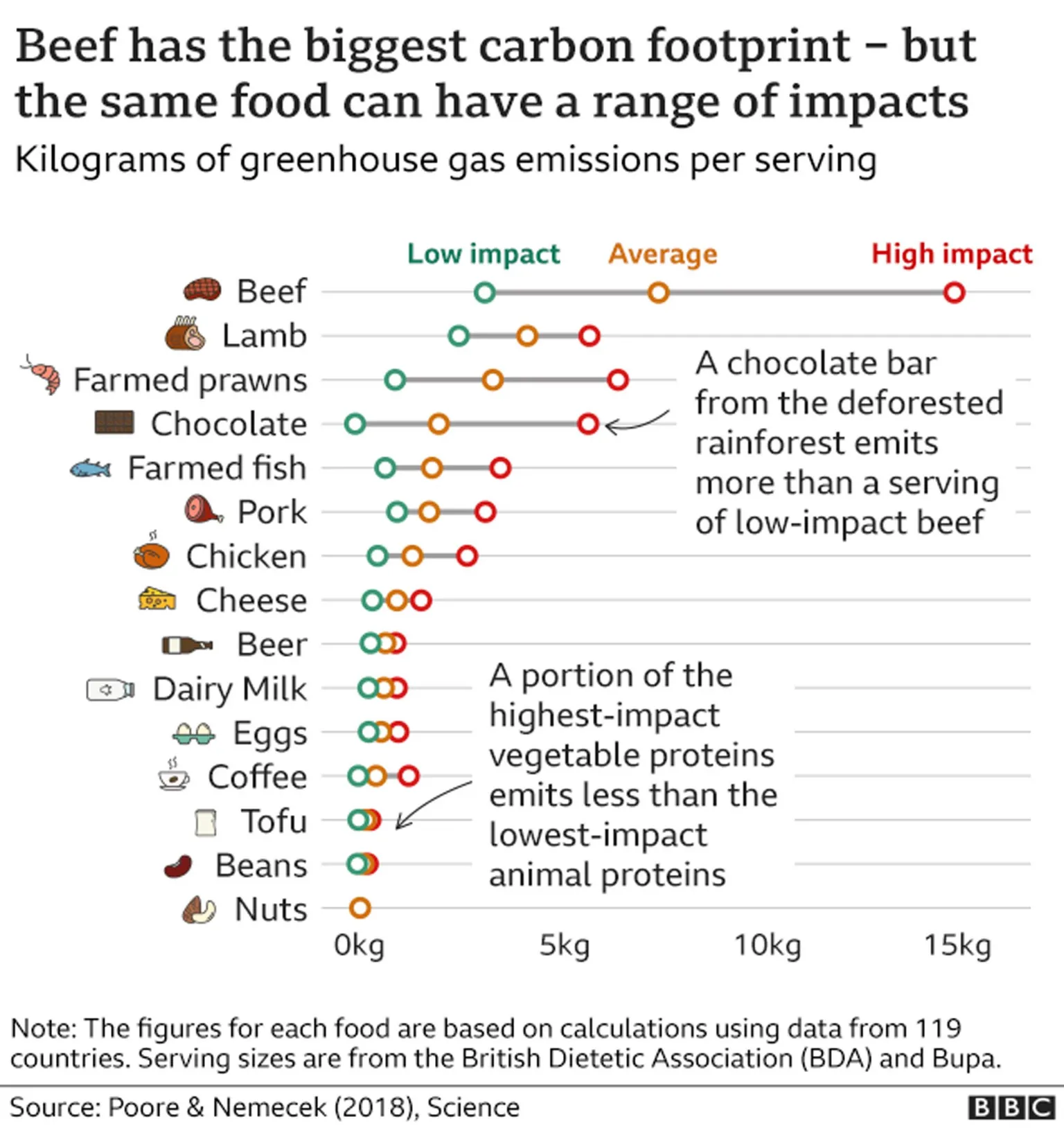
Something oft forgotten: cheese made from cow milk is actually really inefficient too. Chicken and pork meat rank lower than cheese from cow milk in environmental impact.
By this approach, life is inherently wasteful. Resource use is not only necessary, but a human right. Deciding for others what is and isn't worth the use is immoral.
What kind of statement is that? Is it my human right to blow CFCs into the air? Maybe, yet we generally disallow that because it would ruin the fun for everyone else. Your right to use resources ends where my impact begins.
Additionally, pointing out inefficiencies is a good thing and something we should do more of, because that's how we optimize.
CFCs are prohibited, like other toxic substances, because they are unequivocally detrimental to everyone. Energy use, agriculture, and husbandry are not.
> Your right to use resources ends where my impact begins.
No, it doesn't. If it did, no-one would be able to zero any resources as the planet is a zero-sum resource pool.
I have the right to use resources even where it impacts other. The limits we place on resource use are and should be only in extremis where that impact reaches a level that is particularly harmful.
Many agricultural practices meet this condition and have been banned. Many more should be. However, that does not extend to dictating that resources cannot be used for husbandry.
Following your logic, I should be able to prohibit you using computers recreationally, prevent you from travelling in powered vehicles, prevent you from having children. Each of those has a far higher contribution to resource use than husbandry.
> Additionally, pointing out inefficiencies is a good thing and something we should do more of, because that's how we optimize.
Life is not an optimisation problem. Don't waste yours approaching it this way.
You're conflating acknowledging inefficiency with advocating for totalitarian control. I pointed out that meat production is wasteful that's just a fact. Your response is to claim I must therefore support banning computers and children?!
That's not how optimization works. We can improve systems without descending into authoritarian micromanagement. By your logic, we should never fix anything because someone might take it too far.
> I pointed out that meat production is wasteful that's just a fact.
There are wasteful (and horrific) forms of husbandry, but it's not a fact that meat production is wasteful. That's an opinion that's contingent on the assertion that meat is not worth the resources used for production.
> Your response is to claim I must therefore support banning computers and children?!
Yes, I am showing you the absurdity of your statement. Exactly the same logic can be used (and is used by those with extremist opinions like your own) to show that reproduction, computing, travel, medicine, art is wasteful, because it's subjective whether any result is worth the resources required.
> That's not how optimization works. We can improve systems without descending into authoritarian micromanagement. By your logic, we should never fix anything because someone might take it too far.
To be clear, your statements above are already taking it too far by declaring for others what they should be able to spend their resources on.
The fallacy here is that we're somehow, magically, required to move on to more extreme forms of the same logic.
No we're not. We can decide to stop at any time. We don't have to be logically consistent in how we decide rules. And, in fact, we aren't.
Consider, for example, free speech restrictions in the US. You can't yell "fire!" in a theater. Why not? Because it incites distress, and can cause harm.
By that logic, shouldn't we also ban all mean words? I mean, they might incite distress, and they can cause emotional harm, and even physical harm if someone gets too offended.
But wait, wait... isn't "mean", in it of itself, subjective? So then doesn't this mean that this same logic could go for any arbitrary words, technically? Okay, then we should ban all words, right?
No. Wrong. We shouldn't do that. Everything is a case-by-case basis. WE decide when to continue and when to give it up. Not you, not logic.
> The fallacy here is that we're somehow, magically, required to move on to more extreme forms of the same logic.
Yes. It's inherently subjective whether animal husbandry is worth the input resources and each person can decide for themselves is it's worth it or wasteful, as with every other example (travel, medicine, etc).
> By that logic, shouldn't we also ban all mean words? I mean, they might incite distress, and they can cause emotional harm, and even physical harm if someone gets too offended.
Yes, again you're agreeing with me. We collectively choose the boundaries of acceptable behaviour and practices. We have speed limits but don't ban cars, we regulate e-waste disposal but don't prohibit computers, and we can and should forbid cruel and environmentally damaging practises in husbandry, but not ban meat production.
The person I'm replying to is making the opposite argument, that husbandry is inherently wasteful and therefore should be subject to regulation. That is the is–ought fallacy, which I pointed out using reducto ad absurdum.
I think there is a third option, factor in the externalities and treat it as a luxury. The cost we are paying for it is not currently reflected on the final price.
My grandparents and great grandparents in Greece used meat as a garnish a few times per week for dinner. The most meat they would have was at the end of the Lenten fast on Easter where they would have a big piece of lamb. Otherwise, it was the occasional smaller pieces of ground meat on top of vegetable-heavy dishes.
Putting such absolute choices in front of people basically never works. Those conductive to such and argument have already become vegetarian.
But there's a much bigger percentage of people that would be willing to eat meat less, without fully stopping. Turn meat into a delicacy you indulge in, not the default base to prepare every meal on. Try some indian food, or stuff from other cuisines that rely less on meat. Make that twice a week, you'll probably enjoy it, maybe even save some money.
Sure it's absurd to imagine that people make 0/1 choices, however it's also absurd to reject a 3-line shortened proposition because it seems absolute.
> Those conductive to such and argument have already become vegetarian
Choices are more complicated than "being conductive", for exemple
- opinion change: you're not totally against the idea but not convinced neither. If you're open minded, learning something new or being witness of a context change can make you reevaluate.
- Motivation: there's thinks in your life that occupy your brain and you don't feel free to start another change now, but you might being more disponible to self-actualisation later.
- Event-Trigger: An inspiring talk, movie, or discussion with a friend sometimes trigger you to reconsider your position. I know cold showers aren't that hard and they're great for the body and the mind. I never had to courage to start that new habits but a convincing and motivating HN post might be the trigger to a routine.
> Putting such absolute choices in front of people basically never works.
Indeed. Faced with that absolute choice, I'd pick eating meat and dismiss the entire line of reasoning about meat.
And quite frankly I wouldn't even feel guilty about it: I'm pretty sure I'm already doing more than the average to lower my emissions. As a trivial example: I pretty much use public transport all the time and don't have a car. This alone probably puts me above the average american vegan driving an SUV to go from their suburbs to anywhere, in terms of carbon footprint reduction.
Try "Meatless Monday" is a much more effective message than animal welfare, since it offers a reasonable path that doesn't require changing everything all at once, and doesn't tie your past actions to guilt.
People are highly motivated to push back against animal welfare arguments because it makes them feel like bad people. "You can easily make things better by just abstaining once a week" doesn't challenge their identities nearly as much.
  But even when the authors excluded embedded emissions from sources like transport and packaging, they still found that agriculture generated 24% of GHGs. According to the World Resources Institute, a research group, cars, trains, ships and planes produce a total of 16%.

  It finds that animal-based foods account for 57% of agricultural GHGs, versus 29% for food from plants. Beef and cow’s milk alone made up 34%. Combined with the earlier study’s results, this implies that cattle produce 12% of GHG emissions.
It also implies, by the accounting practices of these papers, that clean skins running feral in Northern Australia account for zero emmisions .. particularly if traditionally mustered.
They aren't fed farmed food, they forage and run wild in the Kimberley and Kakadu, and the environment is well served by routinely rounding them up for dinner and taking pressure from the grasslands.
More or less the same story for camels and wild donkeys.
> Surely chicken in your backyard can be kept without CO2 impacts with some effort.
I’m not sure this is possible, at least not in a typical yard or urban garden. According to one study[1] community gardens in and around cities emit six times the CO2 per serving compared to industrial agriculture. I assume this is roughly applicable to backyard gardens too. I wouldn’t be surprised if this isn’t applicable to livestock—which the study appears to have excluded—but also wouldn’t be surprised if the story is similar with chickens/livestock.
I imagine that even if it is less efficient to grow your chickens in the back yard, it might be possible to approach or exceed current industrial poultry farms in CO2 efficiency. My hunch is that if those farms get incentivized by penalties on CO2 production it would be impossible though.
Does that seem likely to make a difference? The study covered individual gardens as well. The low-tech gardening practices they mention sound exactly like backyard gardens.
Of course. The whole study is about cities, even the first sentences already make this very clear. It has nothing to do with normal gardens, nothing _at all_.
I may have missed the part in the paper which explains why a backyard garden is dramatically different in efficiency if said backyard is in a city versus the suburbs. Could you clarify or point me to the thing you’re referring to?
> - health risks can be minimal depending on the amount and type of meat you eat
Health risks from meat is an US-only issue. Here in Europe we have much stricter regulations on meat, so much so that American meat cannot be imported and cannot be sold here. IIRC (might be wrong on this) Canada doesn't allow importing US meat as well?
A while back, the EU relaxed restrictions on feeding animals to other animals in order to boost trade. Restrictions that were in place for good reason after the BSE crisis.
No. It generally doesn't matter where in the world cows are raised, the important point is the conditions. The health risks cannot be minimized because of antibiotic abuse (antibiotic "superbug" evolution) and pandemic virus evolution of cramming too many animals near people who care for them and wildlife.
> mass unethical treatment (assuming you do not mean the fact that animals are killed) is related to the conditions which are related to price
Source? I really don't buy that more expensive meat producers kill their animals that much more "humanely". And even if the killing was painless, you're still killing tens of animals per year for the sole sake of a tastier meal.
> health risks can be minimal depending on the amount and type of meat you eat
True.
> the CO2 impact again depends on the meat and conditions. Surely chicken in your backyard can be kept without CO2 impacts with some effort.
I trust you raise all the animals you eat, and don't feed them with imported grains? Don't be ridiculous.
> your very existence has a CO2 impact. By your own logic you have two choices …
You're basically telling anyone who's self-conscious about their environmental impact to kill themselves. Great.
I believe there's a good argument to be made, yes. This video [0] by a philosophy teacher convinced me of it. Unfortunately, it's in french so most here probably won't be able to enjoy it.
These come up every now and then, but are explicitly arguing against factory farming, not meat consumption in general. Factory farming is indeed immoral, but is a separate, but related issue to meat consumption.
philosophical viewpoint arguing that human beings are the central or most significant entities in the world. This is a basic belief embedded in many Western religions and philosophies. Anthropocentrism regards humans as separate from and superior to nature and holds that human life has intrinsic value while other entities (including animals, plants, mineral resources, and so on) are resources that may justifiably be exploited for the benefit of humankind.
It's hard to argue that we're not in some way unique when we're the only animals having this debate, and every other carnivore or omnivore (and many 'herbivores,' opportunistically) have no such qualms and happily eat all the other animals they possibly can.
- Pandemic virus evolution of viruses from complex people<->livestock<->wildlife interactions.
- Evolving antibiotic resistant bacteria since livestock are given most of the same compounds given to humans simply for economic advantage, and in some cases, to force-feed animals with unsuitable feed like too much corn in too short of a timeframe. Some CAFO farms, their cows would die if not given antibiotics. [0]
- Water, air, and soil pollution on a large scale. Liquid shit lakes that spread manure into the air with sprayers. Runoff from pesticides and fertilizer used to grow the corn, soybeans, etc. The list goes on.
And, yes, climate change, animal cruelty, and other concerns.. but like condoning genocides, nothing will be done about it because people want their fucking Costco-sized 40 pack of cheap hamburgers, BMW SUVs, and overwatered perfectly green grass and air conditioning set to 68 F / 20 C in Phoenix AZ.
This comment is the opposite of nuance. They literally argued that everything you do has a CO2 impact, therefore you either shouldn't try at all or should just kill yourself.
That's, like, the least nuanced and most caveman-brained take on climate change you could possibly develop.
Also: appealing to edge-cases as a distraction isn't nuance, it's derailing. I can find fucking exceptions to anything. ANYTHING. How many people in the West are growing their own chickens? Give me a fucking break man.
I‘m trying to find something resembling a reasoned argument in your comment, but there‘s nothing except profanity.
I did not point out exceptions and the chicken example is merely an illustration of one of my points.
And who says we are talking about the west? Plenty of comments in this thread are talking about pandemics, something that is not known to originate from western agriculture.
You know what‘s a caveman take? Thinking that there is any chance to convince a meaningful number of people to reduce meat consumption globally in the required time window (20-50 years) in a way that has any bearing on climate change (as opposed to the many steps being taken that actually work). That‘s a caveman take.
As you can see, the type of meat matters a lot. Cheese is doing worse than pork in this example (not sure I even believe this without more evidence yet). Non-meat sources of protein don‘t do very well: Tofu is just 2x better than poultry. Compare this to the giant bar for beef.
In short, yes, it would be theoretically possible to eliminate about 10% of global emissions if everyone everywhere stopped eating meat and replaced it with a balanced non-meat diet.
But such an outcome is not realistic.
This is my last comment on HN. It is sad what this corner of the internet has become.
> You know what‘s a caveman take? Thinking that there is any chance to convince a meaningful number of people to reduce meat consumption globally in the required time window
The "caveman take" I'm referring to is when you implied the correct solution to climate change is suicide.
It's a caveman take because I've heard it numerous times, and it lacks all nuance or thought. Yes, we emit CO2 by existing the way we do. We can improve our situation without going to extremes. This is a "perfect is the enemy of good" type thought process.
It's what I call an anti-solution. It doesn't solve anything, but it does completely halt the conversation and makes sure that other real solutions can't pop up.
> As you can see, the type of meat matters a lot. Cheese is doing worse than pork in this example (not sure I even believe this without more evidence yet). Non-meat sources of protein don‘t do very well: Tofu is just 2x better than poultry. Compare this to the giant bar for beef.
Okay, but none of this was in your original comment. You talked about raising chickens, which I appropriately clocked as a not real solution that isn't going to work.
Eating more chicken and less beef is good, I agree, and a reasonable solution. You should probably lead with that.
except for the fact that cows exist within the carbon cycle.
And the biggest contributor to greenhouse gases is that we feed them oil that we dig from the ground.
Cows are extremely convenient scapegoat but truthfully they exist in a closed system that we keep feeding carbon into. Methane itself is very very harmful but lives almost no time and atmosphere experts all agree on this.
It is my understanding that land use (eg cutting down rain forest, draining wetlands) for pasture and soy are a big contributor to the carbon footprint of meat.
What's "funny" is that rain forest land being destroyed for pastures has terrible yield. We would be better off paying the people using them to keep the forest intact.
Could be true, in the countries I am most faniliar with (UK, Sweden) there’s no rainforest and a good chunk of the land used for rearing cattle couldn’t be used for farming Soy.
The cattle doesn't have to _be_ on the same wasted land that is used to feed it. Soy is imported from other countries to feed cattle in the UK (around 2M tons of soy per year[0]).
It is a common and convenient misconception that raising cattle is not bad for the environment because it is raised on non-arable land -- the cattle still gets fed imported soy.
Then the solution is fairly simple. Make the soy more costly than a lesser emission heavy alternative. Cows only need imported soy in order to be marginally cheaper.
But now we're returning to the assumption that everything thats fit for cows is fit for human edible crops.
Cows aren't often eating the "human grade" crops, to my understanding.
I'm not making an argument that we shouldn't scale back cattle-rearing, if anything my personal preference would be to eliminate all oil-based feed and see how sustainable we can make things; I just think we've got a real convenient scapegoat here when the largest polluter is definitely car dependence as it's adding carbon to the carbon cycle.
The cows aren't the scapegoat (no pun intended), it's the human entitlement of expecting cheap hamburgers without paying for the externalities of using the sky as a sewer.
Cows eat "cow corn" (yellow dent corn). 5% of every bit of America is used to grow the stuff; only a tiny fraction is used to grow sweet corn. That's an absurd amount of overproduction thanks to subsidies. It gets inefficiently turned into ethanol and steaks. Instead, in most areas, that land could be used to grow healthier human crops like quinoa, lentils, or sorghum. Commercial sorghum is grown about 2 blocks from where I live.
They don't emit CO2 or Methane in any way that can run out of control unless we pour carbon into the system externally (by digging up oil and feeding it to them for example, or transporting them using cars that run on fossil fuels, or heating them with fossil fuels).
They are a scapegoat, because they can't by themselves emit anything that can't be captured and returned and reused by cattle for essentially perpetuity, yet we as humans are doing things that are not sustainable and contribute to tipping the scales.
> They don't emit CO2 or Methane in any way that can run out of control unless we pour carbon into the system externally (by digging up oil and feeding it to them for example, or transporting them using cars that run on fossil fuels, or heating them with fossil fuels).
The economic incentives combined with political corruption will continue FF extraction. The root problems are human nature and political in origin and require leadership to pull back on grain subsidies, tax CAFO-grown meat, tax fossil fuels (none of this "carbon offsets" in Africa fraud), and pass on the real future decline in GDP from climate change-driven floods, famines, and wars.
FWIW I don't think your points are totally invalid, and it is not me (and maybe not GP) that is flagging you.
That aside, your primary argument if I understand it right is that there is no (or at least diminished) cost to cattle raising because the emitted carbon came from food that was sequestered as part of a cycle.
The problem I would call attention to is that the planet's carbon capacity is simultaneously nerfed by the land required for feed. About 40% [0] of arable crop land is used to feed cattle, a process which faces huge caloric efficiency losses (consider that the caloric output of meat cannot be higher than the input).
It is pretty well understood at this stage that meat consumption is a gigantic contributor to climate change. Anyway, I _also_ agree about cars. We don't need to rely on whataboutism here: we have a common objective. And, by the way, I still eat meat, but much much less than I used to, so I don't mean any of this as an attack on meat eaters.
Where land is converted there can be an increase. But for an existing farm with stable herd numbers the emission produced around (Methane > Carbon Dioxide > Grass > Methane > etc.).
There's industrial beef and there's grass fed beef. Grass feed one preserves pastures which are amazing and rich ecosystems, much more valuable than soya monocultures.
Methane also traps at least 100 times as much heat as CO2. It causes significant near-term warming, and cutting methane gives fast climate benefits. Cutting down on methane emmisions can have considerable more effect on global warming over the next 20 years, compared to CO2 (which we also have to reduce), Atmosphere experts all agree on this.
And "[cows] exist in a closed system" assumes we’re not expanding herds, clearing forests, or using fossil inputs.
The beef with beef is that meat production, and espcially from cows, is extremely energy inefficient. You need 15-20kgs of plants for 1kg of beef, when we could just eat the plants directly and avoid everything needed to seed, grow, reap and haul all that feeding mass, which massively contributes to global warming and consumes ludicrous amounts of water.
To be fair, ruminants can digest the parts of the plant that we can’t digest. A small number of ruminants are part of good agriculture. Of course we’re ridiculously beyond „a small number“
This is overly simplified to the point of being wrong.
Water usage spent on watering crops used to then raise livestock (eg. alfalfa, soy) account for some 70% or more of total water usage in regions where this type of farming is done.
In arid regions (MENA, Saudi Arabia, Iran, California etc), a lot of that water is aquifer water. Aquifers take centuries, sometimes millennia to fill up.
The consequences of emptying these are rivers drying up, native flora dying off, topsoil being eroded and so on. In some cases, Tehran and Mexico City being prime examples, the depletion is sufficient to cause structural changes in the ground leading to literal collapses of land.
Growing food with an order of magnitude less inefficiencies means an order of magnitude less of these consequences.
Because the numbers are an order of magnitude different? [0]
Water needed to produce 4 oz of soy beans: 64 gallons
Water needed to produce 4 oz of beef: 463 gallons
Your points about the carbon cycle are well-taken but you're ignoring the trophic pyramid for some reason. [1] Or at least I find it hard to believe you could know about one without knowing about the other.
Because you can eat the soy directly and remove the additional land loss, water use, soil compaction, acidification, storage cost, transport cost, cooling cost, butchering cost, shipping cost etc. that comes with introducing another link in the food chain.
Feed conversion ratio for beef is something like 1:6-10, and that's ignoring everything above.
By that logic, no human activities are problematic since everything needed to sustain them comes from nature and eventually goes back to it. That's ignoring the tons of wastes generated by the beef industry, the ravaged ecosystems to make room for pastures and farms, the fuel needed to build and power the machinery to manage it all: from tractors to cargo boats to factories to trucks...
The issue is that all that carbon and other mineral resources we dug up to power all of this ends up rapidly upsetting the balance the Earth settled in over the last million years. My point is that we could eat the same amount of calories by generating much less waste and needing much less space and energy.
If we weren't digging carbon out of the ground then a lot of human activities would indeed not be a problem.
I'm sure we can make things uninhabitable without doing that, but, largely when talking about climate change: it's the mere fact that we're unleashing significant amounts of stored energy into a closed loop ecosystem that cannot handle it.
Saying "its all part of a cycle" misses the point. Yes, energy and water aren’t destroyed but using 15-20x more plant matter, energy, and water for 1kg of beef compared to plant based food is still incredibly wasteful. Nature’s cycles have limits, and industrial meat production pushes them far beyond whats sustainable.
Inefficiency doesn't particularly matter if it's a closed system, it only effects how much we can get out of a thing.
If we need 100% efficiency yields because humans are so numerous that there can no longer by any inefficiency in the conversion of sun rays into energy fit for human consumption: then you have a point.
But we're not there, so the inefficiency of food production is not particularly relevant.
Where you and I will agree is that the scale of meat production is unsustainable, as evidenced by the fact that we are feeding cows fucking oil from the ground. If we could sustain a population of cattle and enough energy for human population then I don't see a problem, but that is obviously significantly lower than the scale we currently see cattle-rearing.
How can inefficiency lead to systemic collapse in a way that cannot be reversed inside of a year?
We're not talking about contributing to the carbon cycle anymore, we're talking specifically about converting rays from the sun into human consumable matter.
I think you've come into a reasoned conversation with an idealised take that meat consumption is inherently stupid, and this doesn't not necessarily make sense because inefficiency is totally acceptable as long as the needs of the system are met.
People use python for making websites, after all, one of the least efficient languages available. People move to higher efficiency languages when the system begins to demand it.
You have heard climate scientists talk about tipping points, right? Methane is short lived but extremely potent. Its warming effect can push systems (ice melt, permafrost thaw, ocean circulation) past irreversible thresholds. Deforestation to support meat production isn’t easily undone. Regrowing forests takes decades to centuries.
Ok, so you're continuing to push the topic in a direction of methane and not inefficiency as we were discussing.
I think I'll conclude the conversation here as it's clear you're just conversing from an ideological point of view.
Methane is a problem, as discussed elsewhere in the thread, but the largest issue continues to be the fact we're digging up oil and feeding it to herds, you've not convinced me that this is not the largest issue, or not a larger issue than: air travel, cars etc;
If we just ended agricultural subsidies that artificially lower the price of meat (and fossil fuel subsidies) while taxing fossil fuels at the point of extraction to correct for their negative externalities, this would solve a lot.
Yeah from a protein prduction efficiency point of view, Pork, sheep and goats are way better than Cows. Chicken and fish are even more efficient. And plants win, hands down. We can all make choices that improve our impact on the planet.
Pigs sentience is considered very close to dogs and as dogs have a very intimate place in some culture some people make a connection and don't feel eating them.
Pricing people out of things means only rich people can afford those things. The same rich people that on an individual level generate a lot more emissions than the average person.
From a systems perspective, civilization is the greatest pollutant. Whether it's Mesopotamia, Rome, industrial Britain, or the modern global economy, each civilization is a complex machine that extracts resources, generates waste and disrupts ecosystems. There’s no version of it that’s truly sustainable long-term, just degrees of delay or harm reduction.
There is absolutely nothing special about beef. We could replace beef with palm oil, lithium, air travel, or even data centers. The same system logic applies: convert energy and resources into power, growth, and order, while displacing entropy elsewhere.
A clean planet is a planet without civilization. This is a factual observation, not nihilism.
So you are saying that we should adhere to a binary logic, where we either accept the destruction of the Earth as a fact, or we form a doomsday cult ?
I don't understand. It is quite clear that we are what is polluting the planet, sure.
There are multiple ways to reduce our impact and try to reach some sort of balance. Of course everything is imbalanced right now, we are only a couple of generations after the industrial revolution after all.
Of course it is. Every civilization so far has ended due to internal collapse. I'd love to hear arguments and evidence about why you believe our society is on a different path.
To begin with, a planet can be "dirty" without any civilization. Most planets are. Look at Venus. Our own planet had already gone through 5 mass extinction events before we came up. The Great Oxigenation Event in particular does look like "pollution until planet death" without any civilization involved.
On the other side, it possible to have clean civilization - even one that cleans up more as it advances. You make it sound like it's an inherent problem - like civilization is "by definition" unclean. That is not at all the case. We have seen it is possible. What it isn't, is (as) profitable as simply not dealing with the externalities.
> To begin with, a planet can be "dirty" without any civilization. Most planets are.
They can also be clean. Look at Earth. Don't see an argument here. We are discussing whether civilization pollutes or not, not whether planets are inherently habitable or inhibitable.
Fair point. I was too dismissive in my earlier response, and I apologize. You raised strong and valid arguments. My perspective is shaped by a long pattern of historical collapses, but I’d truly welcome any examples or evidence that point to a different trajectory.
Any living creature would fit that definition of "civilization". A sponge takes up resources from its environment, and releases its waste products into the environment. Non-native species often disrupt ecosystems when introduced somewhere new. So unless you moderate your argument by including some required scale it doesn't make any sense. But it would follow that we could reduce resource inputs and outputs to such an extent that civilization is no longer harmful, which puts a damper on your statement that this is "factual observation, not nihilism".
> Any living creature would fit that definition of "civilization"
It would not. I said civilization "extracts resources, generates waste and disrupts ecosystems". A sponge does not disrupt its ecosystem. In fact, it keeps it alive.
> Non-native species often disrupt ecosystems when introduced somewhere new.
And how does this happen exactly? Non-native species do not just walk around - you need humans and civilization to move them around, and create exactly these kinds of issues.
Ultimately it's about the energy invested to on one hand keep civilization running and on the other dispose of its products in a non-disruptive manner. There's an overabundance of it from the sun, we just haven't scaled up our means of extracting it.
A solar panel throughout its lifetime gathers way more energy than is required to produce it and later turn into materials for new solar panels. There exists a process for that and I'm sure eventually legislation will follow as the number of end-of-life panels grows.
I think OP is saying it's impossible to have no impact - both theoretically and practically.
From a theoretical perspective, that sunlight on your solar panel isn't free - there was some tree or plant who would have used it if you had not.
Even if you build over the ocean, there would be some algae grown with that light and fish who ate the algae.
From a practical perspective, good luck making and deploying huge amounts of solar panels without huge mines for materials, a big road network cutting through the forest to deliver the parts, huge cities for people to live in who operate the factories etc.
> From a theoretical perspective, that sunlight on your solar panel isn't free - there was some tree or plant who would have used it if you had not.
Actually, no. Plants typically use just the two chlorophyll bands and the carotenoids band and they really don't need all of the 1000W/m2 of solar radiation - you see this in how plants in direct sunlight turn red to absorb less. For the same reason they're typically green, not black.
On top of that the Earth's albedo is 0.367 - much of the energy which reaches our planet is reflected back to space.
I was addressing this comment:
> There’s no version of it that’s truly sustainable long-term, just degrees of delay or harm reduction.
Yes, we have an impact on the ecosystem, no matter what we do. But the ecosystem is also able to regenerate and sustainability is just a matter of not straining it beyond that ability. It's entirely feasible, we just need to scale up certain technologies available today.
Ecosystems can repair themselves from moderate amounts of damage and adapt to coexist with the thing that causes it. The problem is that we're causing too much damage too quickly.
It's also entirely possible to sustain a civilization without causing continuous damage to the planet, it just isn't allowed to be constantly growing in population and resource consumption. That's not a necessary part of civilization, it's just the way we're doing it currently.
> That's not a necessary part of civilization, it's just the way we're doing it currently.
All civilizations including ours have been doing it this way, so you can argue it is a part of the civilization. It’s a comforting fiction that humanity can fundamentally change its character, but the history proves otherwise.
The knowledge that our growth harms the environment and will end up destroying the planet and us along with it has not been front and center in those civilisations, so it's not a fair comparison.
My wife and I area treating beef (and pork, lamb, and other mammalian meats) like peanuts, because she got the alpha-gal allergy from a lonestar tick bite.
PSA: check for ticks
ps: the loss of beef/pork/lamb in our diets hasn't really been a loss.
Plants have been producing protein from solar power since forever, but I bet it’s easier to tell the difference between steak and bacteria powder than to tell the difference between coal power and solar power.
> Plants have been producing protein from solar power since forever
Yes, but interestingly enough solar panels + hydrolysis + solein production is more efficient. It takes roughly ten times more land area to produce the same amount of food with plants. And efficiency of solar panels is still improving.
Producing food with solar panels also would not be affected by increasingly unpredictable weather patterns, soil degradation, pests and weeds. It would not require fertilizer, pesticides or herbicides. Water usage would be much reduced.
Obviously this technology is still in the demonstration phase and there is still a long way to go. But it looks like this could be the start of a revolution in food production of a magnitude similar to the Haber process.
No, they taste 100x better and they're called plants.
Eating animals that graze all day on the scant plant life was a necessity in many parts of the world. But in places where plants grow in abundance like India and Central America they eat them either exclusively or predominantly and their food is delicious as a result. These days the rest of the world has much better access to fresh vegetables too. I can even grow many desi vegetables in a greenhouse at home. So ditch the tasteless chunks of animal protein and eat more plants.
Coal and renewables output the exact same thing (electricity), beef and alternatives don't. Unless they make money from coal, people don't want coal, they want electricity and they won't even know the source. But in this case people want beef. Almost every beef replacement failed so far. So it's not as straight forward as "treating it the same" because at least one generation of people will always know what they lose. The hill is steeper for this battle.
Tell that to my FiL. I dread his family gatherings since I know hockey puck burgers are going to be the only viable food on the menu because he's very proud of that expensive grill he has no talent with.
I'm not sure what you mean by 3). We have a perfectly good "digital currency" and have had it for decades, it's called a bank account. I can click four buttons on my phone and a friend gets some money within 30 seconds. As for inflation, economists think a 2-ish-percent inflation rate is a good thing and work to keep it around there. To them it's not something to "tackle". Not saying I agree with it...
Or just start with eating less meat, learn to cook and identify which vegetables you need for a balanced diet.
The recommendations / sciences - which predate concerns about greenhouse emissions etc - for how much meat you need per day is about 65 grams, or about 1/2 quarter pounder in American measurements. In macronutrient language, you only need about 46-56 grams of protein a day (https://en.wikipedia.org/wiki/Dietary_Reference_Intake#Macro...).
I won't deny that good beef contains heaps of both essential macro- and micronutrients in a convenient and tasty package, but people really don't need as much per day as they are eating.
1) Do you have numbers to help use compare ? I have no idea how much methane was unleashed during this single event. So it's pretty hard to compare with to the impact of cattles. (I have a suspicion it's a drop in an ocean.)
2) You are right, they are hypocrites. At least you can vote some of the politicians out - unfortunately, their electorate The bad news is that physics does not care about their hypocrisy. The good news is that neither do we have to - we can make a lot of choices ourselves. Including what we eat, how we heat, and who we vote for.
3) Why do you think "everyone" is flocking to bitcoin ? [1] the usage is still confidential enough. The GHG impact is therefore hard to evaluate ; sure it might use a lot of electricity (about as much as a small country [2]), but it depends on how valuable you value the thing.
I don't think bitcoin is more usefull than a big "gambling ponzi scheme", but I understand people have other opinions. Do you use bitcoin daily ? More than you national currency ? More than other digital services.
4) Do you believe those things to be exclusive ?
In turns of carbon, we need to "turn off lights" (I suppose you mean "reduce our own consumptions") _and_ demand that AI be at least powered by carbon heavy sources (or - unpopular opinion on HN - consider not using them too heavily ?)
But we also need to lobby for building carbon-light electricity sources.
AND we need to reduce the impact of agriculture.
The fact that some people are oblivious to the impact of activity A does not remove the impact of activity B.