If anyone actually believed it was "code red for humanity" they'd be pushing nuclear power. There is zero chance of moving off carbon energy sources without causing catastrophic mayhem, unless we use massive amounts of nuclear.
For instance, the last 4 years my state has averaged 37% production of total possible installed wind generation capacity. This is a very windy state which is in the top 2 for installed wind capacity and number one per capita. But throughout a day wind power can very from nearly zero to close to max capacity. Those periods of near zero production can last non-trivial amounts of time no realistic battery could provide for.
The only solutions are continue with our gas turbine/wind power mix where we build enough gas turbines to handle 100% of the load for when the wind production is bottoming out, or replace everything with nuclear.
Nuclear gets us to net carbon zero fastest and with technology easy to export to developing countries in desperate need of plentiful, reliable, cheap electricity.
I see this take a lot, and it’s kind of misinformed. The primary drawbacks of nuclear are:
1) incredible slow to build. A typical plant takes ~20 years from decision to productionized
2) extremely expensive, with a massively frontloaded cost. By contrast, solar and wind are fast to install and now cheaper.
> wind power can be zero at some parts of the day
There are a few solutions to this actually. First, having a more nationalized grid can amortize variant weather conditions (very unlikely it’s not windy everywhere, for example). Second, there actually are long-duration battery solutions coming out. Look up “energy tower” for a very weird one, and “form energy” for a more traditional model.
Nuclear power can be fast to build. It would need to be constructed in volume, with immutable designs. Right now, America builds so few nuclear plants that they are essentially all one-off designs. Mass production is key here.
Vis-à-vis costs, the government can poof into existence trillions of dollars with no ill effects. Cost is an easily overcome obstacle.
If a mandate came down to produce 1000 new nuclear reactors by 2030, I think it could be achieved. The country just needs the political will to make it happen.
> Nuclear power can be fast to build. It would need to be constructed in volume, with immutable designs.
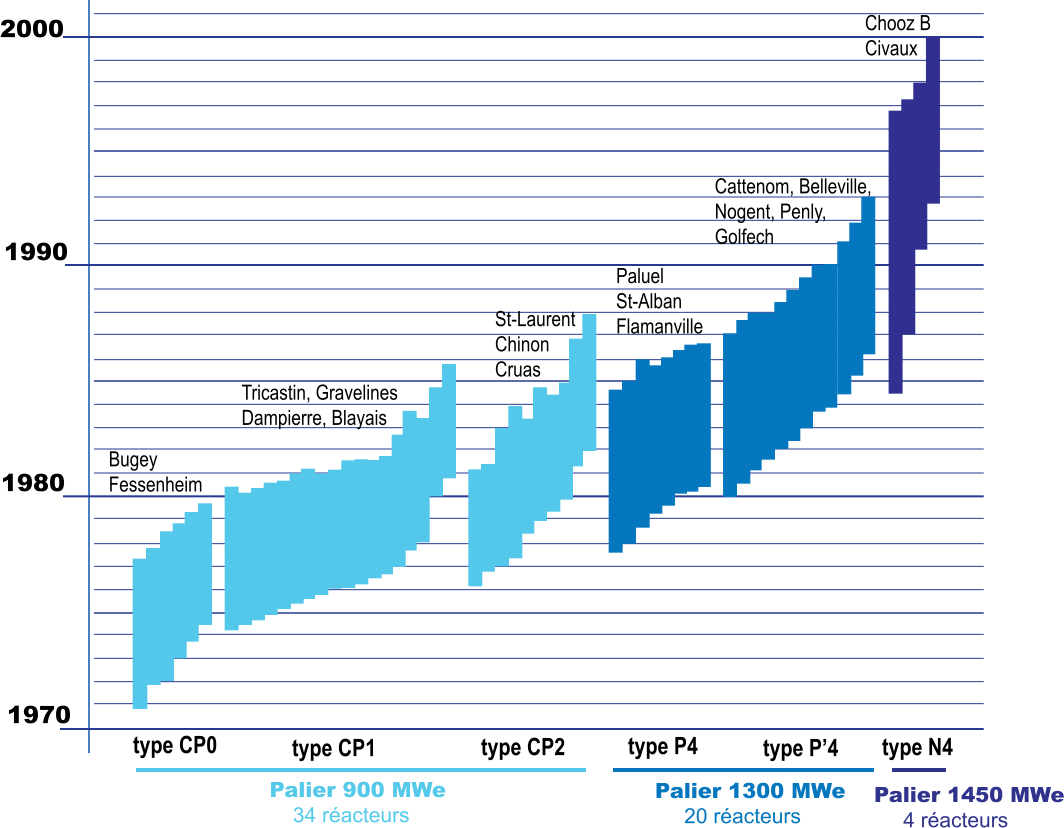
Exactly. You need look nowhere further than the french nuclear timeline for that to be clear: the country grew from 4.5GWe capacity to 49.5GWe between 1977 and 1987. 900MWe class reactors took 5~6 years to build, and the 1300MWe 7 to 8. And when you've worked out the kink, this can be parallelised massively (as long as you have sites to put them on), for about 20 years the country had a dozen reactors being built concurrently, the slowdown in construction times really started as the number of plants being built decreased: https://upload.wikimedia.org/wikipedia/commons/2/24/Chrono-p....
The design got more complex and there were teething issues with the N4, but Chooz took 16 years to enter service where the P3s took 8 years at most.
In 2020, nuclear energy accounted for 70.6 percent of France's total energy production what is stunning, if you take into account its one of the G7 countries:
It gets 70% of its electricity from nuclear, but electricity is only a minority of the energy we use, so France still gets most of its energy from fossil fuels:
I had the privilege of watching a bunch of (6 or 7) French engineers make an impromptu visit to the ticket desk (of the airline I worked for) at Charles de Gaulle airport and work their magic, running comms and power with no fuss, just teamwork and that brilliant "why not now?" European attitude.
Meanwhile back at Heathrow that would have taken months of permits and planning and dealing with useless subcontractors.
Were, things have gotten way less great since the 80s, it’s mostly coasted.
Too bad really: nuclear power was a way to gain independence (from the US and the oil) but then it kinda fell by the wayside as the country largely went with oil anyway (though the grid is both powerful and rather clean owing to the high ratio of nukes).
Would have been interesting for the country to ride the contrarian gallic spirit and decide to go all in on electricity and renewable way back then.
Nuclear power could have been fast to build if we had kept building it. We did not, and most of the people who knew how to do it are now retired or dead. Because nuclear power had no future for decades, few young people chose to make a career in it. The workforce needed for designing, building, and operating nuclear power at scale no longer exists and cannot be trained quickly enough. That alone would take 10+ years, which we do not have.
And thus, we will spend the next 10 years playing around with building piddling amounts of renewable power generation and storage instead of actually having a solution in 20 years.
The best time to plant a tree was 20 years ago. The second best time is now.
> the government can poof into existence trillions of dollars with no ill effects
This is because the federal reserve's printed money goes basically into treasuries and stocks.
The rich save basically all of their money. If they decided to spend it on real-world goods, there would be huge inflation.
But it's probably all nil. The cost of building enough nuclear power plants with economy of scale is probably near the same as building enough solar and wind farms.
Balancing systems do exist - I used to swim in Smith Mountain Lake[1] as a kid and that entire lake is a gigantic battery. During low demand periods they pump water into a reservoir to then run the turbines during peak demand hours. None of these systems are perfectly efficient - but we've got a lot of options in our tool belts for ways to balance peak demand that don't require more continuous production capacity.
Yes, pumped storage does exist, but to provide a nation sized battery using pumped storage, you would need to use two of the Great Lakes and pump one of them up by 200 feet.
The power needs of the occasional cold wind still winter week are fairly large.
Beyond the fact that electricity-generation is once again only part of our emissions issue, there's about ~450 reactors worldwide and the uranium ore reserves give us around ~120 years of operation on current 3rd (/3+) gen reactors (short of having fast neutron reactors basically). Having 1000 in the US (or rather 900 more or 3 times as many globally) would have brought that deadline closer by the inverse ratio, and we'd likely already have tensions on nuclear fuel sourcing.
Agree with you on the role of government spending though, but there also needs to be a radical paradigm shift in how we view the economy and what needs to happen in each sector (not just within energy in fact).
Yes, sure, we can go mine the bottom of the oceans and extract it by centrifuging ocean waters, that probably would give us marginally more than a doubling of margin.
Point remains: reserves are exhaustible, an exponential consumption may not be desirable.
https://en.wikipedia.org/wiki/Peak_uranium#:~:text=As%20of%2....
Recent studies found that re-using a design made nukes cost more & take longer to build. Reason being each site is different, and so the design always needs to be tweaked, and at this scale changes are more expensive than from-scratch.
SMR's made in a factory seem like the only way to address that, but I have no idea if we can ramp SMR's to national viability in the next ten years.
"Why Nuclear Power Has Been a Flop" [0] apparently does a good job of explaining exactly how our civilization has regressed in this sense over the past 50ish years. In short, it's the principle of "As Low (risk) As Reasonably Achievable". Well, they minimized nuclear risk, but sure as hell didn't minimize global warming risk in the process.
Roots of Progress has an interesting review here [0], which is what I base that on. (It's on my list to read, just haven't gotten to it yet)
This isn't practical everywhere, but on the island of El Hierro (Canary Islands) there is a wind-and-battery solution in the form of a wind-pumped hydro-electric station. In effect there is a big pool of water acting as a battery and the wind turbine "charges" it.
When I ran across it on a trip to the island I was really impressed. Very original solution!
If it would be actually climate emergency then we would be building in mountains all where reasonable. No matter the damage to some rare species, panorama and tourism.
Don't forget the substantial costs to clean up. Just think about growing up in a world full of EOL nuclear plants left by generations before you that need to be cleaned up... In a political unstable world due to an ongoing climate crisis.
Even today we as a whole struggle with decommissioning nuclear plants, and the costs are astronomical this is already a huge problem now, let alone in a post climate change world
Just think about a world full of EOL toxic waste ash ponds left by coal power plants, each of them vastly more toxic and teratogenic than any nuclear plant, let alone a decommissioned one.
In fact, you don’t need to imagine it, you are living the dream.
The report talks about hypothetical setup with smart girds and customers reacting on price change. This configuration was never tried at 80% scale. It might or might not work.
People did try decarbonise industrial economy to 70% - it worked with technology existing not now but in the eighties. And it did not put any limitations on consumers, while taking just 10 years to implement.
Surely at code red we should be looking at things that were shown to work?
That I would guess is exactly the strategy China is adopting.
And the west IMO will reel in horror at even a single meltdown there and back off any plans to adopt nuclear the day that happens, wasting precious time we really don't have.
>A typical plant takes ~20 years from decision to productionized
If this were truly "code red" and people really believed that, we would find a way to push the bureaucrats out of the way and build nuclear capacity way sooner than 20 yrs. Humans can do amazing things under dire stress.
This is not happening, so I will assume "code red" is hyperbole, something that the IPCC is not entirely known to shun.
> This is not happening, so I will assume "code red" is hyperbole
If you take the current pandemic as an example of what we do when under dire stress, I don't think we should be that confident. Yes, some people can perform astonishing feats, and yet other people can deny there's even a problem even when it's obvious.
Humans don't always react rationally in code red situations though. Right now the irrational fear of nuclear power is stronger than the fear the average person or politician has of climate change. Doesn't mean that the climate change situation isn't dire.
> I will assume "code red" is hyperbole, something that the IPCC is not entirely known to shun.
I'm not sure that’s the case and I would encourage you to dig into what the worst or medium range scenario would mean. As I understand it, the _middle_ scenario predicts that a billion people would either die in a climate-related catastrophe or be displaced before 2050. That means that several ethnic or cultural groups would go through essentially genocide.
There are details like loss of water reserves in California and the impact on food access in the US, fish population collapse, climate-related migration from the densest populated areas in the world that are very concerning.
I’ve seen scientist give very clear alarms on several global issues (usually my father was making the point); I’ve personally made several myself, and every single time, the reaction was… dumbfounding: trying to minimise, negotiate, taking the most optimistic scenario as a worst case, delaying…
I have, unironically, witnessed several conversations that literally went:
“If you do that, you, your family and your way of life will die forever.
— You are exaggerating, that’s too scary.”
They did nothing, and soon later: exactly what the prediction said.
This is not only the most common scenario, it is the only scenario I’ve seen, with one exception: CFC and the Ozone layer. And that was because there’s a handful of industrials, who had clear alternatives that proved cheaper.
“Other people do nothing; I’d rather believe the reassuring story than evidence” is exactly how we end up with the bystander effect.
Yeah I hear this every time, but very few small modular reactors (SMRs) have actually been built on account of economic and safety barriers to building them [1].
Now, I'm sure these are soluble problems. I'm by no means anti-SMR. But most of the actual serious proposals I've heard discussed for decarbonization lean much more heavily on already-existing technologies such as solar panels, which are getting cheaper and more efficient every year and which we are putting in the grid right now.
Most of the time, when I hear people talking about SMRs, it's as an excuse to do nothing. "This research tech will solve the climate problem, so all we need to do now is wait for it to pay off." Like the original poster in this thread, who claimed that a lack of investment in nuclear somehow proves that things aren't really that bad.
Apparently, the IPCC does expect and hope for substantial increases in nuclear power as a portion of our energy supply [2][3], but "[a]chieving a rapid decarbonization of the electricity sector will require, at first, deploying proven technology," presumably because nuclear on its own is not enough, and because SMRs are too experimental to lean on in any substantial way.
If it was actually code red, we would waive literally all safety regulations and environmental policy reviews, and break ground on new plants tomorrow. And cost would be no object.
Yes. I do actually think it is critical, but it's clear that most people are using "code red" as a semantic device, not out of belief that we should act with _true_ urgency.
I think we're also forgetting that adoption of nuclear power is also dependent on a stable government. Geopolitical risks probably outweigh all the drawbacks mentioned.
Yes it's slow to build today, though it hasn't always been the case: France once built 56 reactors over 15 years [0].
Yes it's expensive, but once again, this isn't a feature of Nuclear power, but one of the capitalist (or at the very least neoliberal) system it is built into: 60% of the Hinkley point C costs are due to the mode of financing (not 100% public) [1].
The real question is not whether this or that type of electricity generation is better (although it's also an important question), but rather how we can completely redesign our socio-economic system to quickly wean ourselves off of fossil fuels (hint: global logistics are far from electrified), reduce emissions from the agricultural sector (we do need to eat), etc.
To me this makes so much sense. But when you look at the costs involved it's far cheaper and less risky to deploy 2x in renewables and a bunch of energy storage plus some gas plants and long distance transmission.
New innovations in nuclear maybe have a chance to change this, but renewables are still getting cheaper so even if they succeed they must still beat the moving target.
In another world where we had embraced nuclear long ago and kept innovating it would have made so much sense. It still will be a part of the solution, but the economics really aren't there and the private sector isn't dumb. Markets will allocate capital according to risks and returns and nuclear will continue to be overlooked until it can compete.
Nuclear is able to compete on merit and has been forever, but we chose to create a legal environment in which one or two dedicated NIMBYs could stall a project indefinitely. That's the entire reason why "the economics aren't there." We aren't talking about costs of building a reactor or risk of it melting down, we're talking about the cost and risk of 1001 strategically sequential ground squirrel environmental impact studies pushing the project duration out to infinity. Allowing this is a political choice, not an evaluation of the technology.
I tend to agree with you that the ship has sailed, though. If we had just kept building at the same pace as 40 years ago (linear extrapolation, not exponential) then we'd recently have celebrated the completion of a zero-emission grid. Unfortunately, we chose to pump the atmosphere full of CO2 instead. Ugh.
It's not really the ahead of time NIMBY complaints but the potential for future liability shifts which existing plants will not be exempt from. A good number of plants constructed in the 60s and 70s hit their EOL (after getting a a bunch of lifetime extensions from governments) and then had their nice glittering warchest of profits eaten away by cleanup expenses (which sometimes exceeded the cash left in those contingency funds with the deficit falling on state & local governments). There have been issues with water contamination due to poor holding pool sealing and due to unforseen natural disasters.
Nuclear power requires millions in its initial investment. It has a not-insignificant profit margin over other power sources, but it also has a significant chance for large liabilities (more often due to changing laws than meltdowns). The result is an investment with an extremely high investment threshold (you don't build small nuke plants) with a decent short term prospect and a poor long term prospect that's extremely hard to get out of. This makes nuclear a really bad option for private investors when held up in comparison to tech and the like.
Meltdowns can happen and they're catastrophic but the bigger impediment is the unpredictable legal and fiscal liabilities involved. And, honestly, it's my personal opinion that a fair amount of these post-de-facto fiscal liabilities are extremely just and fairly applied - they're externalities we were ignoring decades ago.
This is a segment of the market where we need government funding and guarantees to get things done - and we should do so since nuclear is an extremely safe and clean option for power generation.
Let's ask the ad engineers. :) I don't like the historical alternatives but our current society (in general) approach for social-economical organization reached it's threshold and made us waste human potential tackling artificial problems while ignoring those that were right in front of us. But who knows as those "blind investments" generated knowledge that might be critical for the next decades.
"Hinkley Point C nuclear plant to run £2.9bn over budget"
> Last week, prices for new wind power delivered by 2025 were set at prices as low as £40 per megawatt hour. By comparison, power from Hinkley Point C is expected to cost £92.50 per megawatt hour.
I don't think NIMBYs are the only problem. Nuclear is just too expensive to build and maintain, especially with dirt-cheap renewables and storage coming down too. I have some hope that SMRs or something will end up working out, but like you say, I think it's mostly too late.
Only because any accidents, while rare, are incredibly high profile.
Where's the compensation for all the deaths due to coal plants? Unlike nuclear, they spew carcinogenic crap in the atmosphere by design. And some radioactivity too.
Unfortunately markets are not good at accounting for those kinds of external risks (but they could be with the right incentives, like a carbon tax.)
It's a tragedy of the commons scenario. I don't understand why politicians don't just do the hard/right thing. Supposedly that's why we have them. If they always just do the popular thing we could cut them out of the picture and go to direct democracy. I'm not advocating for that, but we need politicians to step up and do their jobs competently.
The way in which markets properly account for climate change is to suffer so much damage from the effect that the market collectively agrees to internalize the costs to the climate into prices of exchange - this price adjustment might not happen before cataclysmic levels of deaths or a tipping point that makes climate recovery infeasible and coping as our only recourse.
Additional taxes, in the US at least, as currently seen as being contrary to the American experiment by a large enough segment of the population that consensus won't be gained when, while driving on the highway, we see the bridge out ahead sign - nor when we see the cliff in the distance - nor even when we feel the front walls fall off into air. We'll reach consensus when we look out the front windshield and see the earth racing up to give us a kiss... At least that's my pessimistic opinion.
> deploy 2x in renewables and a bunch of energy storage plus some gas plants and long distance transmission
Is it actually sufficient? Feel free to link even technical sources (as long as it is not paywalled without way of checking quality).
My impression is that right now "bunch of energy storage" is 100% unfeasible to provide power from renewables without blackouts. And existing ones work thanks to nearby countries with scalable non-renewable on demand power, with rare exception of countries with low population density and great opportunity for hydropower that is available on demand.
I'll turn that around and ask specifically why that's not possible.
It would require a better interconnected grid, overbuilt renewables, and plenty of storage with some level of on demand generation like gas. A good percentage of baseload power like hydro and nuclear certainly help, but it's not required.
It's just a matter of how much are you willing to spend as opposed to something that's physically impossible.
I believe renewables + grid scale batteries are already cheaper than new nuclear and much lower risk and much faster to deploy. The momentum is in favor of widening that gap.
Currently power storage is tiny, even largest hydropower projects would be insufficient to provide backup power in most places.
And just 2x renewables overbuilt would regularly run below demands - sadly solar/wind is not acting on demand. And during drought also hydropower may be unable to work.
And in most places hydropower, geothermal is unable to provide enough power.
(please correct me if I am wrong! But last time I checked nearly no place can run on renewables without relying on importing fossil-based power, and places that succeed have ideal places for hydropower/geothermal)
The big unknown to me here is the impact of the interconnects. It's obvious that the intermittency problem gets smaller with better transmission infrastructure. What I can't recall seeing is actual studies of how much transmission capacity would be needed to average the renewable input over large enough an area so that existing storage solutions are adequate.
Also, not all renewables are intermittent. Apart from hydro, geothermal comes to mind. (Although with climate change-induced changes in rainfall it's not clear that hydro will be reliable on the timescales we talk about either....)
I think this is a question of what is grid scale. Is the Tesla facility in Australia grid scale? Why not? What about the large facilities being planned currently with lithium ion batteries?
My source for my previous comment is Bill gates’ book.
Aside, I think a big battery in Australia makes a lot of sense because they have lots of sun year round and lots of unused space. So you are pretty much just storing for night time and can easily build solar panels.
In many other places, you have to store for much longer term which means you need much bigger batteries (and bigger generating plants).
This is to say I think the cost in a place like Australia may be 100s of times less than places in most of the USA (which is where I live).
> In many other places, you have to store for much longer term.
Yeah, that doesn't make sense. Overbuild and interconnect rather.
You can't do things like store summer solar energy for the winter. But there are plenty of places in the US where the sun is nearly always shining. If you can share that energy across the county you're in good shape. Likewise with the wind.
Again it helps you have solid baseload power. It's just nuclear is so expensive and takes so long to build that you can build twice the capacity in solar and wind plus a battery, plus a gas plant for a backup in less time and for a similar price.
> "bunch of energy storage" is 100% unfeasible to provide power from renewables without blackouts
Telsa’s prototype in Australia was able to prove you can stabilise a grid at scale, profitably and with simple enough technology. In addition to Li-ion (that provides good response) you can have gravity-based capacity (essentially a crane), heat-storage (rocks kept at 4000ºC feeding a thermal power plant) and liquid-metal batteries. Two of those are mostly century-old tech redesigned for a word with cheap intermittent energy; the third seems like the best, most reliable, simplest, most scalable idea out of MIT from the last decade.
I have the impression that these represent enough options, with enough evidence that it will be profitable within a short lifespan, so I’m not even sure you want government support. But if they can facilitate permits, access to the grid, etc. why not get the help? All those will stabilise the grid no matter what source of power we have, so why not implement what we can at scale, see how it helps, and double it six months later if it works? After five years, we should have enough to tell how much wind and sun it can cover but I can’t see why it wouldn’t handle 100% of demand. All of those ideas can be any size, from a hand to a large city; all have many alternative elements to adapt to circumstances, price point; there are complementary and work well together.
Are you sure that any of them is feasible at grid scale? How much it would cost to store 451 GWh (one day of electricity production in Poland if I read https://en.wikipedia.org/wiki/Energy_in_Poland right)?
How large overbuilt of renewables would be needed to avoid blackouts during windless snowy winter months?
Individual projects? No idea. But Poland has a lot of mines, so a lot of room for gravity-based storage.
My suggestion is to build:
* 1 GWh capacity of those gravity-fed; and
* 1 GWh of concentrated solar heat storage — it won’t be as effective in winter but let’s try; and
* 1 GWh of Li-ion batteries; and
* 1 GWh of hydro-storage; and
* 1 GWh of liquid metal storage.
And see which one scales, and what cost, with what retention, reactivity, how is the maintenance. All should, there’s no reason a larger pile of rocks doesn’t retain heat any less well than a smaller pile, or that what you can’t get from one mine shaft doesn’t work in another mine shaft. If you think that’s too much for Poland, let’s try one in Arizona, Iceland, Australia, Kazakstan, Hawaii, and see which one works best and adapts to Polish climate.
I’ve never seen an inventor that didn’t iterate from a working prototype (which we have for all these) to a larger one, to a larger still, until they hit scaling issues. And I don’t know of currently salient scaling issues in any of those (that haven’t been addressed recently — there were targeting problems with concentrated solar that found a solution recently for instance).
“Will it scale?” isn’t the questions that an engineer would ask on any of those at this stage of the project, but rather: "How fast can we make one twice bigger?" When we hit roadblocks that can’t be fixed, we can ask about scale, but right now, all those have a clear path.
"Overbuilt" assumes that renewable capacity doesn’t adapt to winter condition but it might: cooler external temperature could mean that geo-power, or heat stored from the summer represent a higher differential, and more energy. Or it assumes that capacity is expensive, which has never really been the case with variable prices: not for gas plants, not for renewables that are not constrained by context.
If you are worried about European winter overall, that makes sense, but the solution for that is rather obvious — enormous, but so much cheaper than anything else comparable: giant capacities in North Africa, big cable through Spain and France. From there, the extra capacity in Europe can serve Northern Europe. Scandinavia continues enjoying their massive boost in renewable hydro in winter, and the winds in the North Sea will definitely need exporting too. “Windless winter” isn’t apparently a common thing there. That might require more international solidarity, but people will do that quite keenly if there’s money to be made.
While I agree Nuclear is the most probable solution it's not easy to build and fuel is very sparse. France who is leading the way is 100% depend on other countries, I'm not sure it will play well in the coming years
> 85% of uranium is produced in six countries: Kazakhstan, Canada, Australia, Namibia, Niger, and Russia.
And the second issue is to focus on electricity production, while there is a ton a other things creating pollution. You won't save the planet if you still have thousands of ships on the sea and planes in the air; meat and clothes production too...
There are a dozen of topics to be addressed, with multiple solutions and I would say none of them are being really tackled. (except energy in the less efficient way = no green worldwide grid)
> You won't save the planet if you still have thousands of ships on the sea and planes in the air
Aviation contributes only 2% of global air pollution, though maybe 5% of global greenhouse effect (due to the high altitudes airplanes operate at). Textile production, indeed, contributes more to climate change than aviation and maritime shipping combined [1].
However, with abundant electricity you can switch many transportation modes to electric, and (where technical constraints don't allow that yet, eg intercontinental aviation) maybe utilise synthetic fuels.
> I would say none of them are being really tackled
I would say many challenges are being tackled, and the intensity will increase even further.
The altitude thing makes it a little more complicated than that, but… yes, essentially:
1. any flight that could be a train journey, make it so; if anything, luxury high-speed train is so much more enjoyable that whatever flying allows at the same cost; there will be electric short-distance planes soon, but we probably want to use those for over-seas journeys;
2. no matter what source of CO2 will remain after we address ICE cars, coal, red meat, dairy, cement and much more, we will need to go negative to restore sanity to the climate, so pulling CO2 will be essential.
The message is: all hands on deck, starting by the big stuff. Flying isn’t huge, but it needs addressing.
Basically, some gliders do have an auxiliary engine they can use to avoid ditching it the fields or possibly even to self launch from an airfield without the need for another place to tow them aloft or a glider winch.
Traditionally this engine used to be petrol powered and most still are, but electric ones are proliferating quickly as they have quite a few advantages.
For one they are much more likely to actually start if needed during flight, as there is much less moving pieces and oil/fuel that can go bad during prolonged periods of not being used. The startup is basically instant so you can keep lower margin before deciding you will not find that next thermal and engine power is needed.
The limited range is not much of an issue for a glider as its build to fly between thermals without an engine anyway, this being very efficient with insane glide ratios. The online just needs to compensate the few meters per second of height lost before you find the next upwards going column of air or to reach the next airport, so that your friends don't have to fetch your from the middle of the field + you can avoid the field disassembly of the plane to a the trailer.
For self-starting gliders electrical power also makes sense, as they really need a lot of power for just a few minutes to get to height and can then shut the engine down. A compact battery & electric motor provides just that.
I know, it’s awesome. The best part is that they are trialling the commercial options where I am (Northern Sweden) so I should be able to fly soon in one of those and go to Stockholm under one hour without polluting.
> Aviation contributes only 2% of global air pollution
Whataboutism, one of the identified discourses of climate delay [0]. Besides, the proportion of radiative forcing (what actually matters) caused by aviation is more than twice that [1].
0. It's not Whataboutism, though. I don't point to an entirely different problem and say, what about that. I say, if we want to tackle climate change, we ought to target the most effective and cost efficient reductions in order to get the most results with the least cost. And there I say that aviation is just a small part of the problem, so, say, even entirely dismantling aviation would not solve the problem.
1. Yes, as I said immediately following the part you quoted: > though maybe 5% of global greenhouse effect
From the article linked above: "(...) We call this whataboutism. Actors advancing this discourse often deploy statistics demonstrating their own small contribution to global emissions, or they point to large emitters such as China – “We are a nation that produces 1.8 per cent of global carbon dioxide, so I do not get closing down our aluminium smelters, most of our steel production, and now our refining industry …” "
Either we start giving get out of jail free cards to specific sectors and so on or we agree that everything needs to reduce its emissions by ~8%/year from now on, regardless of their share in total emissions, and of how hard it is technically to decarbonize.
Third is the political problem. The international community has some tight limitations on who can refine Uranium. That's reasonable in a lot of ways as an effort to limit nuclear proliferation, but countries don't exactly like being put in the position that they can produce nuclear energy but only if 100% of their supply chain is outsourced to current Western powers.
> 85% of uranium is produced in six countries: Kazakhstan, Canada, Australia, Namibia, Niger, and Russia.
So there is a major uranium producer in every corner of the world? That's better than oil and many elements critical in electronic. Like whats your benchmark" it cant be as common as dirt.
This is definitely a non-exhaustive list - for example a lot of initial Soviet Uranium stock was mined in the Czech Republic (then Czechoslovakia) and contributed to it being forced to the Soviet sphere of influence.
While most of the mines are no longer active I'm sure there are still reserves that could be mined by modern methods (ideally without political prisoners doing the mining this time) and I'm sure there are more places like this.
Greatly reducing meat production, particularly beef and other ruminants, will have a smaller effect than many people expect. Even if we don't eat them, vast numbers of ruminants will still need to exist because they are a critical part of natural ecosystems.
Humans made space for their preferred ruminants, like beef, by displacing vast populations of other ruminants which have similar climate impact. I don't think most people fully appreciate just how large the natural population was before we started raising beef at scale. Even if we eliminated the beef herds, other ruminant species would immediately start filling the vacuum.
> Humans made space for their preferred ruminants, like beef, by displacing vast populations of other ruminants which have similar climate impact. I don't think most people fully appreciate just how large the natural population was before we started raising beef at scale. Even if we eliminated the beef herds, other ruminant species would immediately start filling the vacuum.
The problem with beef farming is that vast amounts of forest are burned or clear cut to allow cattle to graze. That alone raises the carbon footprint of beef. Grass on the pasture definitely doesn't sequester much carbon.
When we talk about wild ruminants, some regions that are used for cattle didn't have a bunch of ungulates on it before. South America for example didn't have huge herds of llamas roaming the lands.
In North America Bison herds were estimated to number about 10 million, but right now there's somewhere around 90 million cattle in the US. Even if cattle farming was drastically reduced, it's unlikely Bison numbers would return to their historic amount. Deer are the other part of the picture, and their numbers would sky rocket, given the opportunity. But that's where managing their numbers and reintroducing predators comes in.
I don’t know where you are getting data for ruminants in North America. Historical estimates for bison are 60 million prior to systematic extermination, at least 10 million for elk, 50-100 million for deer, plus pronghorn, moose, etc in the many millions each.
Bison may not rebound very quickly but something needs to fill the bison niche in the ecosystem. It is well-understood that several other native species undergo population declines and reducing biodiversity when beef herds are moved out of a region long-term. Cattle and bison are very substitutable for this purpose (and are related species). Deer fill in much faster than most other species of ruminants in North America, usually detrimentally.
I was going off my memory of Bison populations, was way off there, thanks for the correction.
Either way, we'd still be better off if we dramatically reduced cattle farming and restored some or all of that habitat, particularly in South America.
Agreed - if the situation is as dire as presented then nuclear fission is the only clear solution today for baseload power. All the rebuttals I usually read seem to present hypothetical alternatives that may very well come to fruition but we have nuclear as a well-tested and known solution to the problem ready for us to begin using today should we simply decide to act.
I don’t see a path forward without Nuclear. Europe and China has done better in this area than US. There is a bunch of fear mongering in liberal California circles about Nuclear. Well informed and technically minded people I know in Bay Area all support Nuclear power.
Frankly the media has done an awful job of fear mongering with the term “Nuclear” and “Radiation”.
New York just decommissioned the Indian point nuclear plant [1] due to some shady politics. The largest planned solar installation in the US was defeated by environmental groups because it would be an eyesore [2].
At some point we’re going to have to grapple with the fact many “concerned” groups don’t actually care about climate change. Instead they use it as a stalking horse for other political projects.
The group that stopped the solar installation was something called "Save Our Mesa":
> But a group of residents organized as “Save Our Mesa” argued such a large installation would be an eyesore and could curtail the area’s popular recreational activities — biking, ATVs and skydiving — and deter tourists from visiting sculptor Michael Heizer’s land installation, “Double Negative.”
The group itself is not in any way an environmental group, they claim to be locals who want to save their tourism industry.
> The majority of our community’s revenue comes from tourism. We lost a lot of tourism and businesses when the shrinking lake levels of Lake Mead occurred closing a nearby beach. We have struggled but built back our economy through OHV tourism. When people come and camp/hotel for a week, they buy our gas, our groceries, eat in our restaurants, use our mechanics and parts stores. This allows these businesses to thrive thus keeping us self sufficient. Feedback from many of our Snowbirds was that they would look for new places to go, that’s lost revenue. People would not come to recreate, that’s lost revenue.
I did read the article. Specifically, I read the second to last paragraph which states,
> Although a majority of the state’s voters approved an energy transition ballot question last year, large-scale projects like Battle Born Solar have drawn backlash from conservationists, endangered species advocates and local businesses that cater to tourists.
But you don't need to take anyone's word for it. Here is a local group very proud to assist Save our Mesa to kill the project [5][6][7].
If you would like to read more about how environmental and conservation groups sometimes oppose renewable energy projects, you can do so [1][2][3][4].
1) Save Our Mesa is the group that pushed back, successfully, against this project, to further the tourism interests in their town, according to the article and according to them.
2) Some infrastructure projects "like this" (i.e. not necessarily this one, but simply projects "like this") draw backlash from environmental groups for whatever local reason. (also, this does not mean Save Our Mesa, the group responsible for stopping this project, is an environmental group.)
3) A local group (Basin and Ranch) was happy that "grass roots killed this project" and they were "happy to help" (in an undisclosed way) -- this also does not mean that "environmental groups" stopped the solar installation "because it would be an eyesore," which is what you said in your original post.
Look, I get that environmental groups sometimes behave in ways that seem irrational, too focused on some small local issue (Basin and Ranch likes the tortoise habitat more than they like solar), but this kind of sliding different issues, takes, positions, etc., together is dishonest and shitty, whether intentional or not.
It's a whole bunch of dissimilar designs - maintaining all that must have been nightmare.
In comparison here in Czech Republic & in Slovakia we have a bunch of upgraded VVERs and that's it, providing a good chunk of our electricity with reasonable commonality.
But hey, it could be worse than in Germany! You can build a complete nuclear power plant with all the expense it entails and then newer run it! ;-)
I really wonder what all the China talking point sorts will do the day China not only beats us on emissions per capita but also on total emissions? What excuse to continue doing nothing will they pivot to then? India?
>Those periods of near zero production can last non-trivial amounts of time no realistic battery could provide for
There are many options (electrochemical, gravity etc) for grid-scale energy storage of various durations that are commercially-viable today. 0-8 hours tends to be the most needed duration in the US but there are solutions that can store power for days or weeks without losses. Even in a 100% nuclear or gas-fired world storage is critical. During the Texas blackout both nuclear and gas assets failed due to the cold temperatures.
Besides the fact that electricity generation is merely one aspect of GHG emissions (hello agriculture, land use, transportation, etc). The ultimate argument against the "let's not radically change our ways and only retool the engine" view is the following: we have ~120 years of known reserves for the current fission reactors, with a potential 10x multiplier with fast neutron reactors should anybody (other than the russians and the chinese) bother to invest into researching the field. How many more doublings in our economy (and hence energy use) does it take to consume it all ? At a measly (by economists and politicians standards) rate of 2%/year, you get a doubling every 35 years. in 350 years (yeah I know this sounds very far in the light of the current news) we'd have increased our demand by 3 orders of magnitude...
While it's true that the state has to backstop the externalities of nuclear through insurance guarantees, the obvious and present externalities of carbon burning massively outweigh these guarantees. The state picks up a huge ROI by covering nuclear risks while taxing the living shit out of carbon pollution.
> If anyone actually believed it was "code red for humanity" they'd be pushing nuclear power
In theory. I used to say the same thing until recently. Now, I'm not sure.
Let's say we decide that yes, nuclear is the way to go, as it provides a lot of energy with barely any pollution (other than mining and construction). The 'waste', while a problem, is inconsequential compared to spewing crap in the atmosphere.
Let's also assume that the designs will not cause proliferation concerns (we have such designs, as well as more plentiful fuels). In fact, let's assume we will use the best designs we have in general.
Even then, what's the turnaround time to construct new power plants? The figures I've seen suggest it takes almost a decade until a plant is operational. Do we still have the time do build them in enough numbers to make a difference?
I'm tentatively in favor of more nuclear power plants, but I'm not convinced it's the only solution. We definitely need more electricity that comes from non-carbon-emitting sources, but solar and wind seem to be winning on cost.
In order to rely more heavily on wind and solar, we will need either enormous batteries or better power distribution across the grid.
Lithium iron phosphate cells should be pretty cheap in mass quantities, and they don't require nickel or cobalt. They can also last a very long time, so cost is amortized over many years. If the batteries cost $100 per kwh and a typical household needs 30 kwh to get through a 24 hour cycle, then that's $3000 worth of batteries per household. The real cost would be higher when you add in battery management systems, chargers, inverters, and so on, but if it's centrally managed it doesn't seem like the manufacturing, installation, and operation cost would be insurmountable.
In terms of the energy grid, I think it would be a good idea to look into constructing major transcontinental high voltage DC lines so the United States can buy solar power from, say, Algeria when the sun is shining there and sell surplus power to Europe and Asia when it's daytime in the U.S..
To sum up: I think nuclear could be a part of the solution, but it isn't the only option. We do have alternatives.
I'd love to see new reactors come on line, but I remain skeptical that nuclear power will be widely used in the US as long as it remains so scary to so many people.
It's scary because disasters stay on the front page for months if not years, it's associated with civilization-ending weapons, radiation and the illnesses it causes are mysterious, we don't really have a great plan for dealing with waste, and nuclear advocates are (by-and-large) a bunch of energy nerds who actually believe some new reactor design or statistical analysis will finally convince the American public to go pro-nuke.
The scarier climate change becomes, the more people seem willing to accept nuclear power. But that could be too little too late.
Nuclear is an especially sensible option in my country (Australia) IMO; we have an abundance of uranium ore, a geologically stable continent, a high-quality interconnected electrical grid (over most of the population), and a reliable political/governance environment. It would be an enormous improvement over our current reliance on coal-fired generation for base loads.
Let's not forget that there are many regions in the world (say in the middle East or Africa) where the situation is constantly volatile to put it mildly and where a nuclear power plant would be impossible to be secured properly against insurgency.
Wasn't Bill Gates going to build a new type of reactor [0] before Trump became president and shut down US/China collaboration [1]?
It seems there's some movement from Mr. Gates around nuclear again, but not sure if the Natrium stuff is the same as the TWR (travelling wave reactor) of 5 years ago. [2]
As pointed out in he comments below, the climate crisis will reduce political stability. And stability is essential to ensure that there will be a strong enough society left to properly decommission a nuclear plant when it will be EOL in 50 years. Decommissioning is likely to be vastly more expensive than initial construction, and after that you still need to figure out how to make sure no one will want to touch the waste for the next few thousand years.
For the current crisis we need to put a cap on carbon extraction now, and quickly bring extraction rates down to zero. Let the price of oil rise and capitalism should sort it out. Only when fossil fuel prices rise to say 500 USD per barrel will people and industries start effectively reducing consumption. Other than on extremely energy intensive activities (transatlantic flights) fossil fuel prices are just a rounding error.
If you can't sell people on nuclear power, there is no way in hell you're gonna sell people on extreme taxes on oil. And even if you could, the base load problem will still be there.
Maybe if carbon were heavily taxed it would incentivize energy storage solutions but as of right now cost effective solutions are no viable yet.
We can at least try putting a price on fossil fuels. Actually the 1973 oil crisis had a profound effect on behavior, so yes a capitalistic system is perfectly capable of responding to something being (artificially) scarce. OPEC should really get their shit together and start another oil crisis "in order to save the world"
Can you kindly edit your comment to remove the accusation that people worried about nuclear power don't believe in the severity of climate change? These people are just looking at a different risk assessment.




For instance, the last 4 years my state has averaged 37% production of total possible installed wind generation capacity. This is a very windy state which is in the top 2 for installed wind capacity and number one per capita. But throughout a day wind power can very from nearly zero to close to max capacity. Those periods of near zero production can last non-trivial amounts of time no realistic battery could provide for.
The only solutions are continue with our gas turbine/wind power mix where we build enough gas turbines to handle 100% of the load for when the wind production is bottoming out, or replace everything with nuclear.
Nuclear gets us to net carbon zero fastest and with technology easy to export to developing countries in desperate need of plentiful, reliable, cheap electricity.