Space is so ridiculously big that I don't think it will ever happen.
Back of the envelope math - 4.2 light years to the nearest star that's not the sun, current vehicles traveling about 10x the speed of voyager (e.g. 1 light day in 5 years). If something was launched today it would get to the nearest star system in about 7,660 years (assuming that star system also a radius of 1 light day).
100x faster than current (1,000km/s) would still take 76 years.
Definitely not before 2100 and almost certainly so long after that we will seem like a primitive civilization compared to those that do it.
> current vehicles traveling about 10x the speed of voyager
As I understand it, not really. Parker Solar Probe is crazy fast, but only because it has that trajectory, and is unable to just change course and keep that speed in other directions.
If you want to launch something for deep space, the Jupiter-Saturn slingshot is still the most powerful trajectory we know of.
Today's rocket engines would give the probe a higher initial speed, but the final velocity would not differ dramatically. A fair bit higher, but not orders of magnitude.
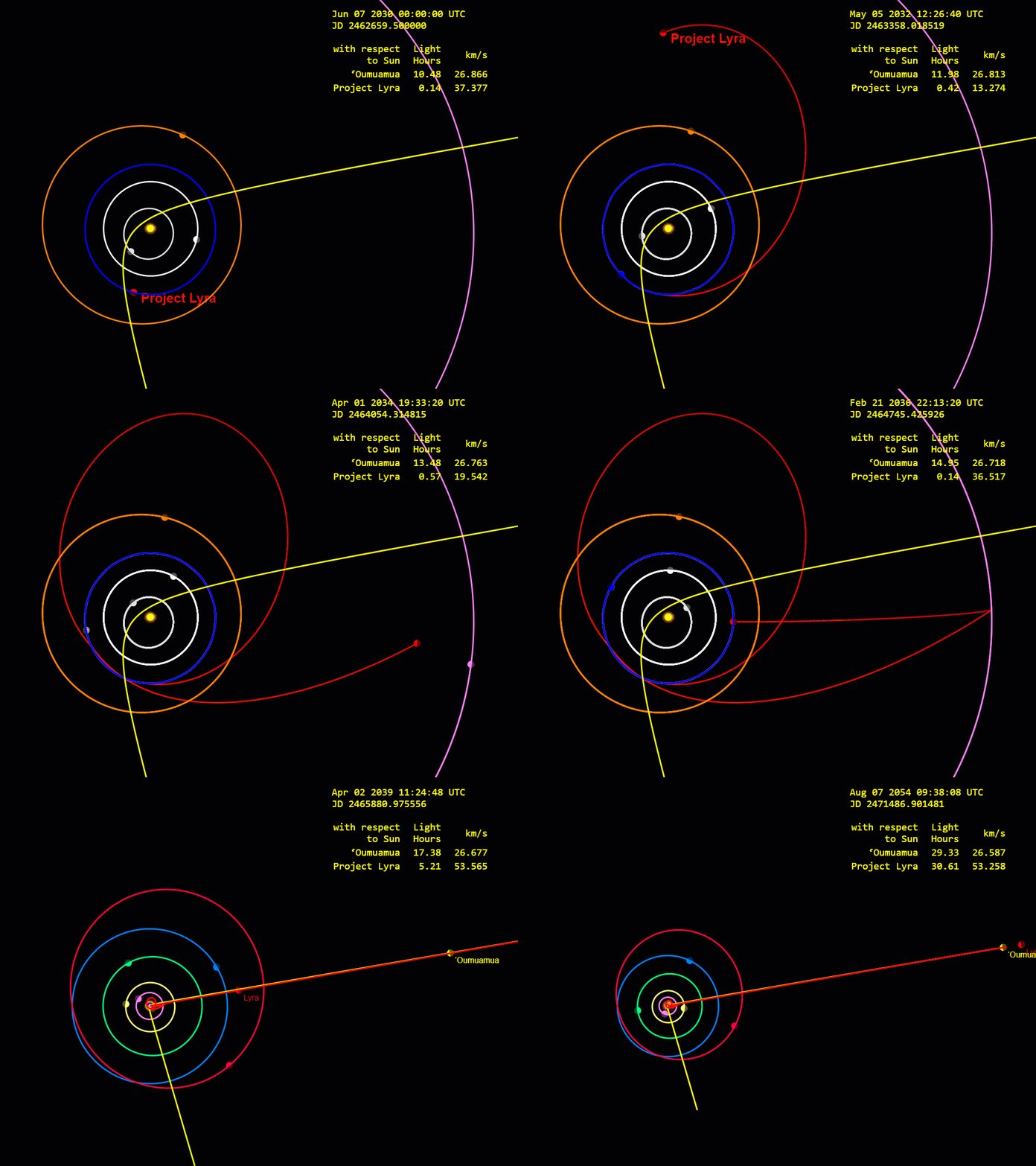
You can do a Sun-diving Oberth maneuver too. Project Lyra was a proposal for an `Oumuamua flyby that got over 50km/s: http://orbitsimulator.com/BA/lyra.gif
> Space is so ridiculously big that I don't think it will ever happen
You are underestimating acceleration. To travel and come to a stop at 4.2 light years, a spaceship with 1g acceleration barely needs 3.5 years in relativistic ship time (~6 years earth time).
The technology to sustain 1g acceleration through 3.5 years is a different story, but very much within our understanding of physics (and not warp drives, etc). 20-50 years of engineering can get us there.
I want to believe, but I think it'll be a lot more than that. The rocket equation is a stone cold bitch in this case.
Sustaining the thrust that accelerates a probe at 1g is very different to sustaining the thrust to move the probe and all the fuel. And it's much worse if you want to stop and not just fly past into deep space.
I think you are way too optimistic. Even with an antimatter drive and 100% conversion efficiency, such rocket would have a fuel to payload ratio of >1000.
Our moon landing missions had a similar ratio, so I assume we can do the engineering to make even a slightly worse ratio work for us a 100 years after it.
In practice it would be better with slingshot maneuvers and picking up mass on the way.
Whatever speed advancements we make on earth, they pale in comparison to sling shotting off of a planet. to make an engine that can go significantly faster, we would need the energy of a planet.
No, it probably can not be a chemical rocket. Nuclear, yes.
My point is that we are in the realm of just needing new engineering (how to make nuclear reactions, or even antimatter-matter collision work for this goal), not new science (warp drives, something else we don't understand about space or gravity, or mass).
Humans might one day have settlements around the solar system and in free space (large stations, etc.), but I have doubts about whether we'll ever go to the stars.
For machine intelligence, though, it would be easy. Just switch yourself off for a few thousand years.
It's likely that our "children" will go to the stars, not us.
Unfortunately at the current trajectory, it will be Grok that reaches the next star system first. Just imagine interplanetary immortal AI sycophantic towards a very specific billionaire
Just spitballing, but maybe it would be possible with relatively modest advances in ion thrusters, and one (admittedly less-than-modest) breakthrough with fusion.
It's maybe too speculative to even matter, but I don't think it's _crazy_ to imagine a handful of AI-fueled advances in materials discovery during the next decade or two. Possibly enough to unlock laser fusion, or something that could be crammed onto a spacecraft.


Back of the envelope math - 4.2 light years to the nearest star that's not the sun, current vehicles traveling about 10x the speed of voyager (e.g. 1 light day in 5 years). If something was launched today it would get to the nearest star system in about 7,660 years (assuming that star system also a radius of 1 light day).
100x faster than current (1,000km/s) would still take 76 years.
Definitely not before 2100 and almost certainly so long after that we will seem like a primitive civilization compared to those that do it.