> But any preventive measure will have limits as what and how serious an impact it can deal with.
The recent grounding of a large container ship in Baltimore's harbor channel demonstrates that a sufficiently massive berm will stop any ship. What's needed is the will to do something about low-probability but catastrophic events (though large-ship collisions, groundings and fortuitously harmless steering failures are frequent enough that this should not have been dismissed as a low-probability event.)
In this case, the nearby towers supporting transmission lines across the channel seem to be better-protected against ship collisions than the piers of the bridge.
Starting from xoa's calculations above, assuming you can pack a berm with well-compacted soil enough that it can absorb 1,000 joules per cubic meter, you'd need a buffer of something like 10 meters surrounding each piling with 3 meters of depth to keep it safe from this kind of impact. That's 10 meters in every direction from the center of the support -- let's assume the support has a thickness of 0 meters for the sake of the math, and acknowledging that the gaps between structural supports on the bridge is approximately 30 meters -- the only way to protect it with earth is to make the bridge impassable by water. Of course, this would protect it from ship strikes.
Even if it takes 10 meters to get the job done (in practice, ships will not be coming at the piers perpendicularly to the channel), that is far from rendering the channel impassable.
Secondly, I believe riprap would be preferred to compacted soil (though compacted soil did a pretty good job stopping the Ever Given three years ago.)
Thirdly (and rendering the above moot), what's been done around the replacement Sunshine Skyway bridge in Tampa bay (mentioned in other posts here) shows that protection is, in fact, practical.
In view of these considerations, I'm not even going to check if, for example, xoa considered the energy absorbed by the ship (Update: in fairness, I did take a look at what xoa wrote, and I see that it is you who has introduced the figure of 1000 J/M^3.)
For an introduction to a serious engineering approach to this problem, look here:
I have to say, you guys are all calculating things without any sort of deference to the nature of the soil underneath any of these piers or abutments. Also, you're both off on your other points as well. Sunshine Skyway has in no way been tested, and there are ways to "reinforce" earthen works so that they can handle more force so that you don't necessarily need 10 m.
You guys are doing amateur engineering. Firstly we don't even know what happened here yet. Secondly we don't know the nature of the problem we'd have to solve in protecting any span that would have been at that position. (How deep is the water? How far down to bedrock? Geological nature of the soil? etc etc etc)
It seems almost impossible for us as humans to just give the professionals some time and space to work so we can see what happened. I get that. I even engage in it at times. But you guys are stating things with certainty and almost indignation? Come on fellas.
Just say your peace and admit it's just a wild ass guess that's likely to be wrong in the end like the rest of our comments.
FWIW, I think there are even more errors in my figures. That said, I wasn't trying to bunk or debunk, as much as the grandparent's comment intrigued me enough to wonder "What if earthen barrier?" -- how much earth would that take. My guess was that it would be prohibitive, and that 116,000 tonnes traveling 8.5 knots is just too much to stop. Earth obviously can, as whomever alluded to the Ever Given points out, but a lot would be required. How much? I don't know, but I was just trying to get an idea.
You're right that it's amateur. This isn't remotely what I do. To your point though, I don't have that much confidence that the Skyway bulwarks would do -- I'm sure they're more than adequate in preventing strikes from my 40' sailboat. Probably much more than that. My gut tells me they are inadequate to stop the momentum of 100k tonnes at speed, but if they did SOMEthing, perhaps that would be enough to differentiate between bridge damage and bridge collapse. I can't find any details on how it's reinforced, with what, or how deeply those reinforcements are buried, so this too is wild speculation... but I wonder if it isn't somewhat security theater. My wife is already scared of bridges, and we're Marylanders who frequent that bridge and the (much longer) bay bridge -- putting something down there to calm her nerves enough that she isn't panicking for the duration of every crossing is almost certainly worthwhile, but doesn't leave the nerds much to ponder.
There are other issues with my work, namely that the central span is over 300m in width, not 30, as I had wrongly discovered, ergo the channel is passable even with my extremely half-baked solution.
That said, the dolphin-bulwarks around the Tampa Skyway are interesting. I've sailed through similar and not known their purpose other than to observe that local waterfowl like to line up at them ahead of tidal shifts to catch the fish as they're encouraged by the currents through them.
You needn't stop the ship completely with the berm: just taking up enough energy that the bridge lives for 20 minutes after the impact would be useful.
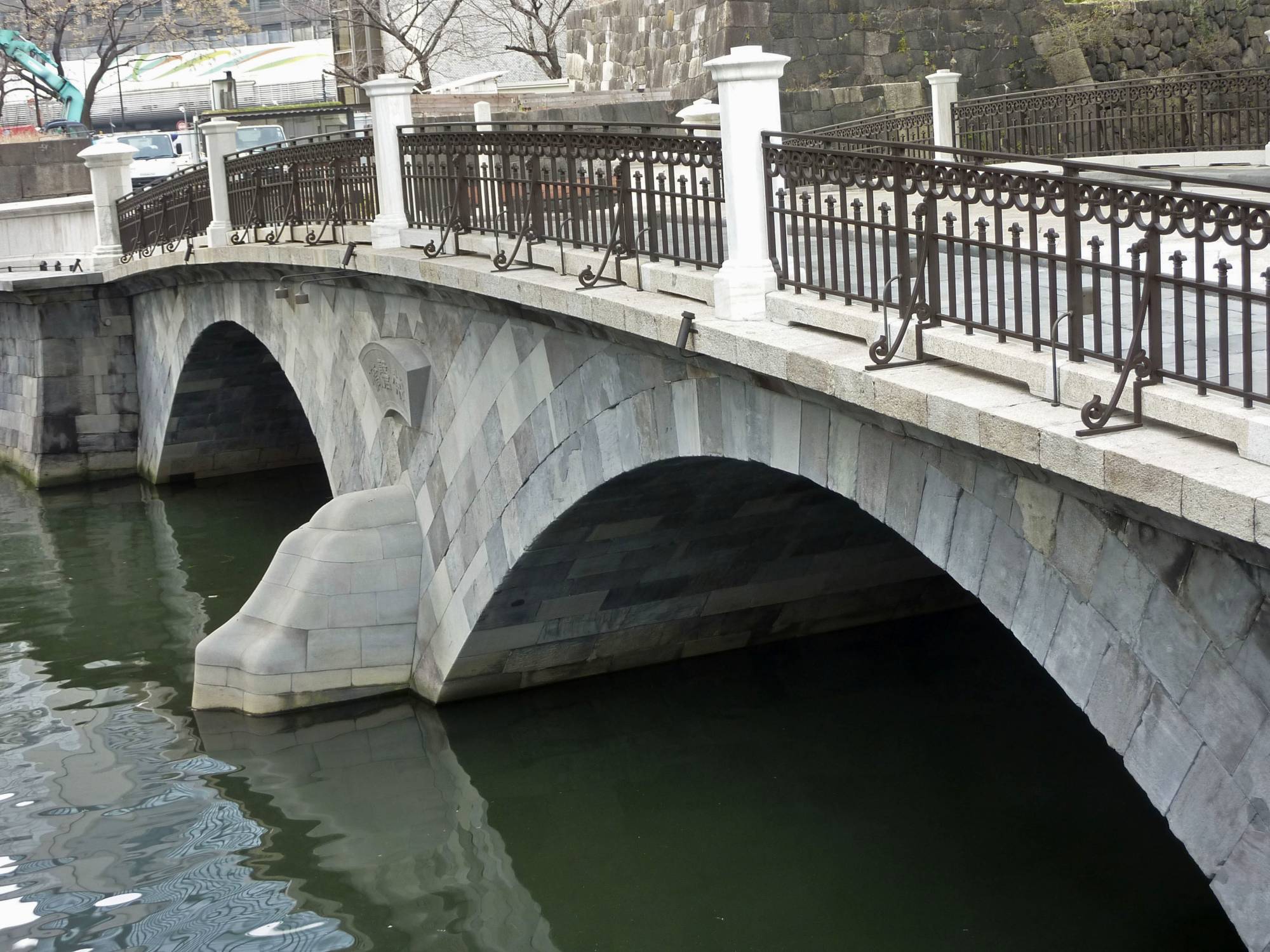
You should look at the deisgn of old stone bridges. Their side facing up ( so towards the floods and ice) is like a wedge pointed upwards. So it's not like he bridge needs a buffer to fully stop all the forward energy. It can lift the object out of the water and maroon it there.
What's needed is the will to do something about low-probability but catastrophic events
In general I share your sentiment society could do more to insure itself against lower-probability catastrophes. But overbuilding every bridge would probably cost more than rebuilding the occasional one that's taken out when an unusual event like this occurs. Maybe in a different environment that would make sense, like a warzone (although I think even then there's more tendency to rely on redundant infrastructure and mobile, power-at-a-point defense).


The recent grounding of a large container ship in Baltimore's harbor channel demonstrates that a sufficiently massive berm will stop any ship. What's needed is the will to do something about low-probability but catastrophic events (though large-ship collisions, groundings and fortuitously harmless steering failures are frequent enough that this should not have been dismissed as a low-probability event.)
https://www.cnn.com/2022/03/16/business/evergreen-container-...
In this case, the nearby towers supporting transmission lines across the channel seem to be better-protected against ship collisions than the piers of the bridge.
https://images.app.goo.gl/J6vTeDW5xjysbdjr9